A prop firm challenge is a set of rules a trader must meet in each phase of an evaluation: a profit target, a maximum daily loss, a maximum drawdown (static or trailing), a minimum number of trading days and a time limit, plus template-wide rules such as a consistency rule. TradeCore's Prop Trading module runs these rules for FX/CFD brokers and prop firms.
Break a loss rule and the challenge ends; meet the target within the rules and the trader moves on, towards a funded account. This guide explains each rule from the firm's side: what it measures, why firms use it, and the details traders argue about. If you are still setting the business up, start with how to start a prop firm.
What is a prop firm challenge?
A challenge is a paid evaluation on a demo account. The trader buys it, trades under the firm's rules and, by passing, earns a funded account with a profit split. The rules are the product: they decide how hard the challenge is, how many traders pass and how much risk the firm takes on when it funds them.
Firms sell four shapes of challenge:
| Challenge type | Phases | How it works |
|---|---|---|
| One-step | 1 | A single evaluation; pass it and the trader can be funded. |
| Two-step | 2 | Evaluation then verification, each with its own targets and limits. |
| Three-step | 3 | Three graded phases, each with its own targets and limits. |
| Instant funding | None | Funded on purchase, trading under the funded rules from day one. |
One-step
- Phases
- 1
- How it works
- A single evaluation; pass it and the trader can be funded.
Two-step
- Phases
- 2
- How it works
- Evaluation then verification, each with its own targets and limits.
Three-step
- Phases
- 3
- How it works
- Three graded phases, each with its own targets and limits.
Instant funding
- Phases
- None
- How it works
- Funded on purchase, trading under the funded rules from day one.
In TradeCore, a challenge template sets six rules per phase (profit target, maximum daily loss, maximum total drawdown, the drawdown basis, minimum trading days and a time limit) plus ten template-level rules, including the consistency rule. Templates are built in a six-step builder.
What is a profit target?
The profit target is the gain, as a percentage of the starting balance, a trader must make to pass a phase. Two-step challenges usually ask for more in the first phase than the second. Example: 8% then 5% on a 100,000 account means 8,000 of profit to clear phase one, then 5,000 more in phase two.
A target only means something next to the loss limits. A high target with tight loss limits is hard to pass; a low target with loose limits passes traders the firm may not want to fund.
Static vs trailing drawdown: what's the difference?
Maximum drawdown is the floor an account may never go through during a phase. Firms measure it in one of two ways:
- Static drawdown measures the floor from the starting balance. On a 100,000 account with a 10% limit, the floor is 90,000 and it never moves.
- Trailing drawdown measures the floor from the account's peak, its high-water mark. As the trader makes money, the floor rises with them; it never falls back.
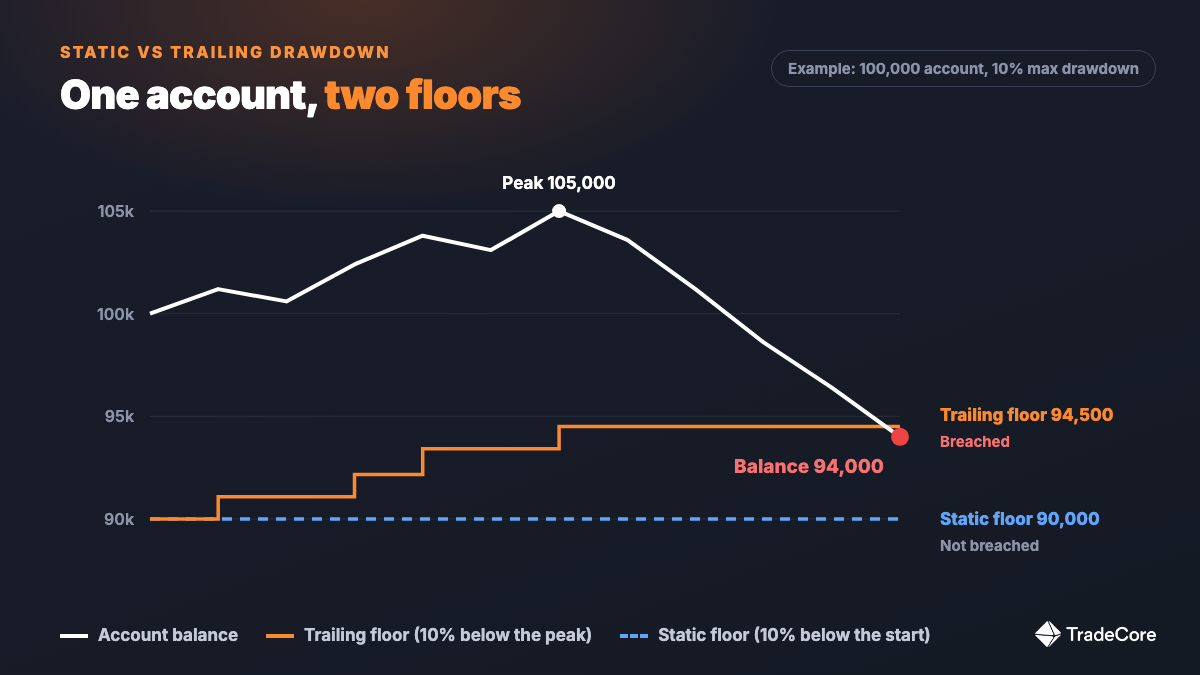
Example chart: a 100,000 account with a 10% maximum drawdown rises to a 105,000 peak and then falls to 94,000. The trailing floor has risen to 94,500 and is breached; the static floor stays at 90,000 and is not breached.
Worked example (illustrative figures, not TradeCore defaults): a trader starts on 100,000 with a 10% maximum drawdown; a good week takes the account to a peak of 105,000, then a bad run brings it down to 94,000. Under a static rule the floor is still 90,000, so the trader is still in the challenge. Under a trailing rule measured as 10% below the peak, the floor has risen to 94,500, so the same account has broken the rule.
Trailing drawdown is harder on traders and safer for the firm, because it protects profit as well as capital. Firms vary the details: some trail by a percentage of the peak, some by a fixed amount, and some stop the floor rising once it reaches the starting balance. Whatever you choose, write it down in the challenge terms in plain numbers.
TradeCore lets the firm choose static or trailing per phase, so a challenge can run a static first phase and a trailing second phase. Each phase tracks drawdown from the peak and drawdown from the start side by side, along with the peak balance a trailing rule is measured from.
How does the daily loss limit work?
The maximum daily loss caps how much an account may lose in a single trading day. It stops one bad session from consuming the whole drawdown allowance, and it is the rule traders break most often.
Three details decide how the rule behaves, and firms differ on all three:
- What the percentage is of: usually the starting balance, sometimes the balance at the start of the day.
- What is measured: closed balance only, or equity including open positions. Equity-based limits catch a floating loss before it is closed.
- When the day resets: a fixed time, often the trading server's midnight, in a stated timezone.
Spell all three out in the challenge terms; most rule disputes come from a trader assuming a different one. In TradeCore, each phase sets its maximum daily loss as a percentage of the account's starting balance, and the phase records the worst daily loss the account has taken so far.
What is a consistency rule?
A consistency rule caps how much of a trader's total profit can come from one day or one trade. Without it, a trader can pass on a single oversized win and then trade nothing like that on a funded account. Example: with a 30% daily cap, a trader who made 10,000 in total cannot have made more than 3,000 of it on any one day.
In TradeCore the consistency rule is a template-level rule. It can cap one day's share of profit, one trade's share, or both, and either cap can be carried over to the funded account.
What other rules do prop firms use?
Beyond the core five, firms add rules that shape how traders trade, not only how much they lose. These are the template-level rules in TradeCore's challenge builder:
| Rule | What it does |
|---|---|
| Risk per trade | Caps how much of the account one trade may put at risk: a soft limit records a soft breach, an optional hard limit is a violation. |
| Soft-breach budget | How many soft breaches a trader gets before the next one becomes a violation, so a first mistake is a warning. |
| Stop-loss timer | Requires a stop-loss on a position within a set number of seconds of opening it. |
| Stop-loss removal prevention | Stops a trader deleting a stop-loss once it is set. |
| Overnight cutoff | Flags positions still open after a clock time in a named timezone. |
| Minimum holding period | Rejects trades closed faster than a set number of seconds, which keeps scalping and latency strategies out. |
| Qualifying day | A day counts towards the minimum trading days only if it clears a minimum profit; can apply to the funded account too. |
| Weekend holding | Allows or forbids holding positions through the weekend. |
| Consistency rule | Caps one day's or one trade's share of total profit. |
| Violation behaviour | Disqualify automatically, or hold the breach for a person to review. |
Risk per trade
- What it does
- Caps how much of the account one trade may put at risk: a soft limit records a soft breach, an optional hard limit is a violation.
Soft-breach budget
- What it does
- How many soft breaches a trader gets before the next one becomes a violation, so a first mistake is a warning.
Stop-loss timer
- What it does
- Requires a stop-loss on a position within a set number of seconds of opening it.
Stop-loss removal prevention
- What it does
- Stops a trader deleting a stop-loss once it is set.
Overnight cutoff
- What it does
- Flags positions still open after a clock time in a named timezone.
Minimum holding period
- What it does
- Rejects trades closed faster than a set number of seconds, which keeps scalping and latency strategies out.
Qualifying day
- What it does
- A day counts towards the minimum trading days only if it clears a minimum profit; can apply to the funded account too.
Weekend holding
- What it does
- Allows or forbids holding positions through the weekend.
Consistency rule
- What it does
- Caps one day's or one trade's share of total profit.
Violation behaviour
- What it does
- Disqualify automatically, or hold the breach for a person to review.
What happens when a trader breaks a rule?
A breach ends a challenge or pauses it for review, depending on how the firm sets the template. Either way, the firm needs a record a trader can see and an operator can defend: which rule, what was measured, what the limit was, and who decided.
In TradeCore, every breach creates a violation record that stores the measured value next to the limit it broke. There are six violation types: daily loss, total drawdown, consistency, time limit, weekend holding and manual (raised by an operator).
On a template set to disqualify automatically, the account fails and the violation is still recorded. On a template that holds breaches for review, the violation stays pending until an operator confirms it or overrides it, and an override needs a written reason. The reviewer and the time of the decision are stored, and TradeCore never deletes the record.
Traders see the same record. In the broker's branded portal, the trader's challenge view shows each phase's progress, the soft breaches used and the violation history with the value and the limit.
How do firms enforce rules on the trading server?
Rules can be checked after the fact, from trade reports, or enforced where the trading happens. Checking after the fact leaves a gap: a trader can keep trading past a breach until somebody notices, and the firm then argues about trades that should never have happened.
TradeCore catches rule violations in real time. Prop evaluations run on all eight trading platforms integrated with TradeCore: MT4, MT5, cTrader, DXtrade, MatchTrader, TradeLocker, ScaleTrade and TraderEvolution. On MT5, TradeCore's own prop plugin enforces the profit target, drawdown, daily loss and time limits on the trading server itself, on TradeCore's free plan and on Core.
Running challenge rules on TradeCore
TradeCore's Prop Trading module builds one-, two- and three-step and instant-funding challenges, records every breach, and moves passing traders to funded accounts with scaling tiers and payouts every 7, 14 or 30 days or on demand. The funded trader is the same client record the firm verifies, charges and supports.
TradeCore's free plan runs Prop Trading's basic edition: one challenge template on sale at a time, with the full rulebook, the MT5 prop plugin, violation review, funding, scaling and payouts working as normal. The full module puts every template on sale at once; see TradeCore pricing. For the business side of a prop firm, see prop firm software.
Put your challenge rules on TradeCore
Start on TradeCore's free plan, or see the Prop Trading module.
Frequently Asked Questions
Related guides
Tags
Ready to Get Started?
Discover how TradeCore can help you build and scale your forex brokerage with our comprehensive CRM.