A profit-share payout is the portion of trading profit that a prop firm pays out to a funded trader from a live (or simulated-live) trading account managed under the firm's capital. The trader keeps a configured percentage of the profit they generate during the payout window. The firm keeps the remainder. The split, the schedule, and the workflow are configured per prop program and apply consistently across every funded trader on that program.
Profit-share is the core economic mechanic of the prop-trading model. A trader pays a one-time challenge fee, passes the evaluation phases, gets funded on a live or simulated-live account, trades to a profit, and requests a payout. The trader/firm split on the payout is what makes the prop model work for both sides: the trader takes the majority share, the firm takes a minority share plus the challenge fee that funded the evaluation cost.
What are the common splits?
Three splits dominate the industry in 2026:
- 80% to trader, 20% to firm. The starting split on many prop programs. Used as the baseline for entry-tier funded accounts.
- 85% to trader, 15% to firm. A common mid-tier split, reached after a trader scales up or demonstrates consistent payouts.
- 90% to trader, 10% to firm. The top-tier split on most programs. Some firms also offer 95% as a marketing-driven differentiator on premium tiers.
The split is configurable per challenge template. A firm can run a program with a flat 80/20 across all tiers, or a scaling program where the split improves as the trader progresses through funded-account tiers (80% starting, 85% after one successful payout, 90% after demonstrated consistency). Tier-based scaling of the profit share is what creates the progression narrative prop firms market to traders.
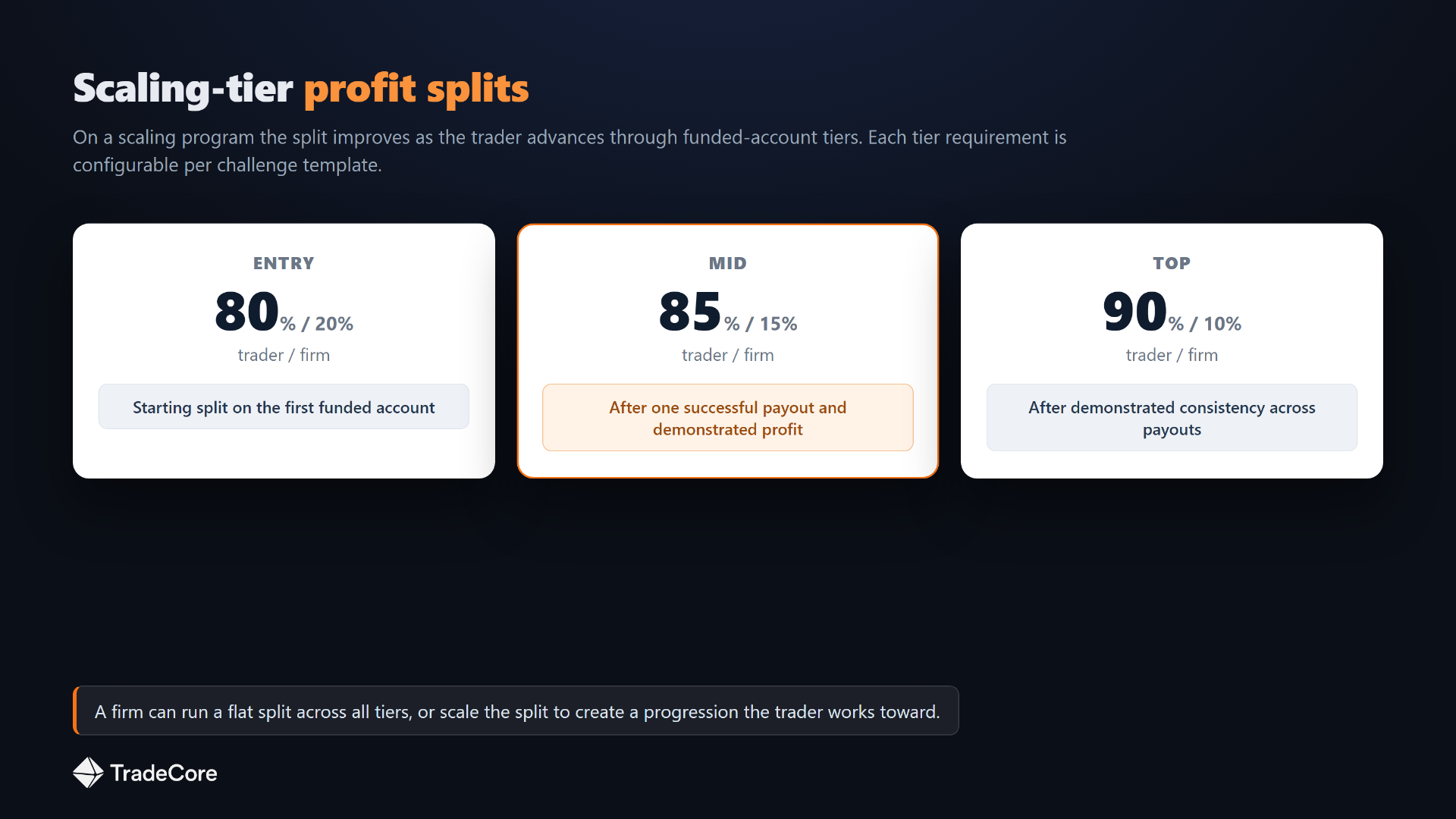
Prop firm profit-share split tiers showing 80, 85, and 90 percent to the funded trader as the account scales up
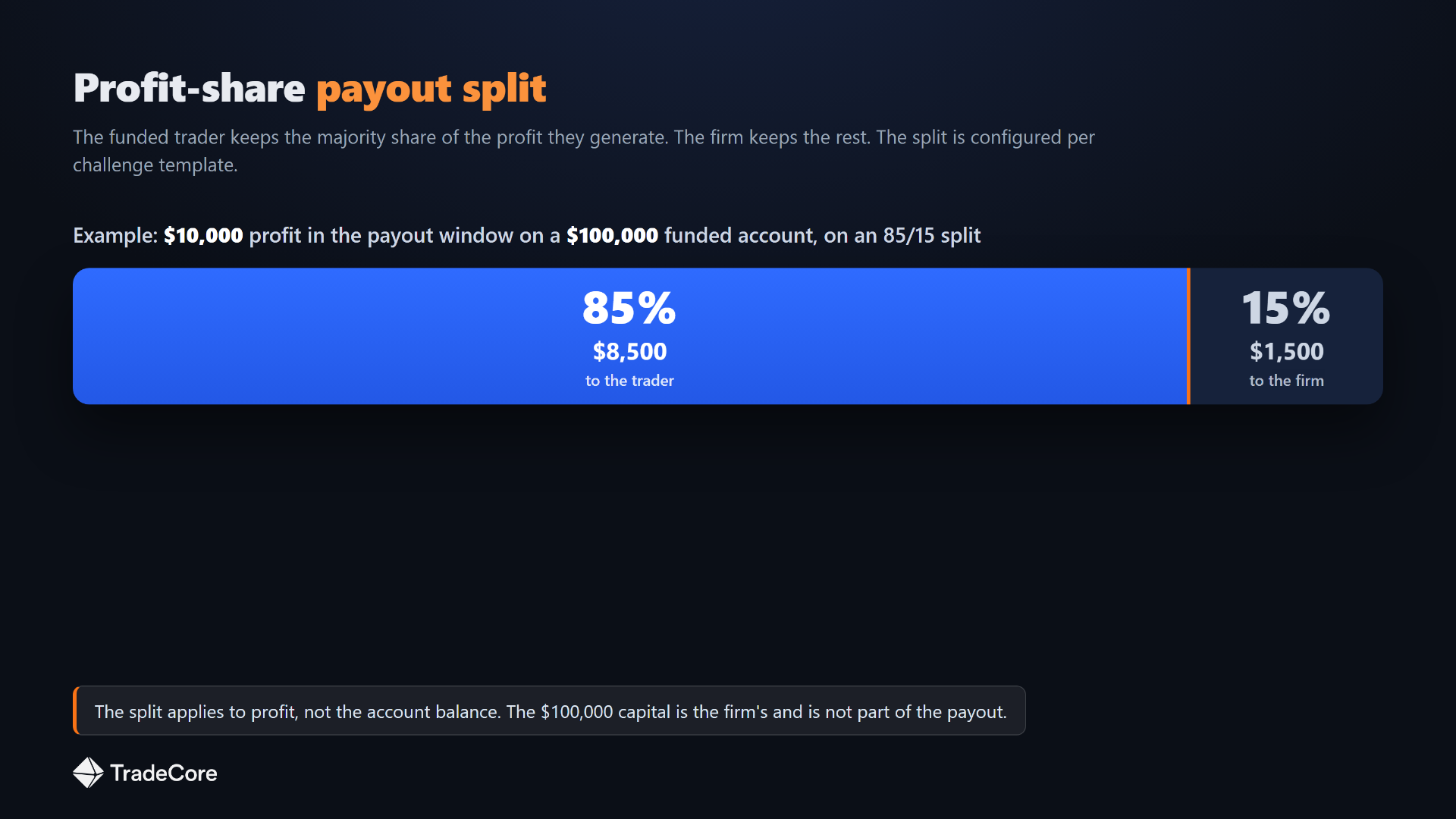
The trader's percentage is applied to the profit on the funded account during the payout window, not to the full account balance. A trader on a $100,000 account who generated $10,000 of profit in the window and is on an 85% split receives $8,500. The firm receives $1,500. The $100,000 account balance is the firm's capital and is not part of the payout.
What payout schedules are supported?
The payout schedule defines when a trader can request a withdrawal. Across the industry, four shapes are common:
- Weekly. Trader can request once per week. An aggressive schedule used to differentiate prop programs that want to attract traders prioritizing frequent payouts.
- Bi-weekly (every 14 days). The industry standard for many years and still the most common.
- Monthly. Used by more conservative programs that want traders demonstrating consistency across a full calendar month before payouts.
- On-demand. Trader can request any time, subject to a configured minimum profit amount. Marketed as a flexibility feature.
Stronger platforms express the schedule as a configurable interval (for example every 7 days or every 14 days) rather than a calendar-bound label, so a firm can run one cycle on a standard program and a different cycle on a premium program at the same time.
Each payout typically has a configurable minimum: a threshold below which a request is rejected, set either as a fixed floor or as a percentage of the account or profit. The minimum prevents traders from requesting trivially small payouts that cost more in processing than the payout is worth.
What is the Pending to Approved to Paid workflow?
Every payout request flows through a three-state workflow:
- Pending. Trader submits a payout request from the prop-firm portal. The system creates a Pending record with the requested amount, the trader/firm split applied, the timestamp, and a snapshot of the trading account at the moment of request.
- Approved. Operations reviews the Pending payout, confirms the trader is in good standing (no recent rule violation, all phases passed, no compliance hold), and approves the request. The Pending record moves to Approved with an approval timestamp.
- Paid. The firm executes the payout: bank transfer, crypto, or whichever method the program uses. Once the transaction completes the record moves to Paid with a payment-reference field (transaction ID, blockchain hash, bank reference) for audit.
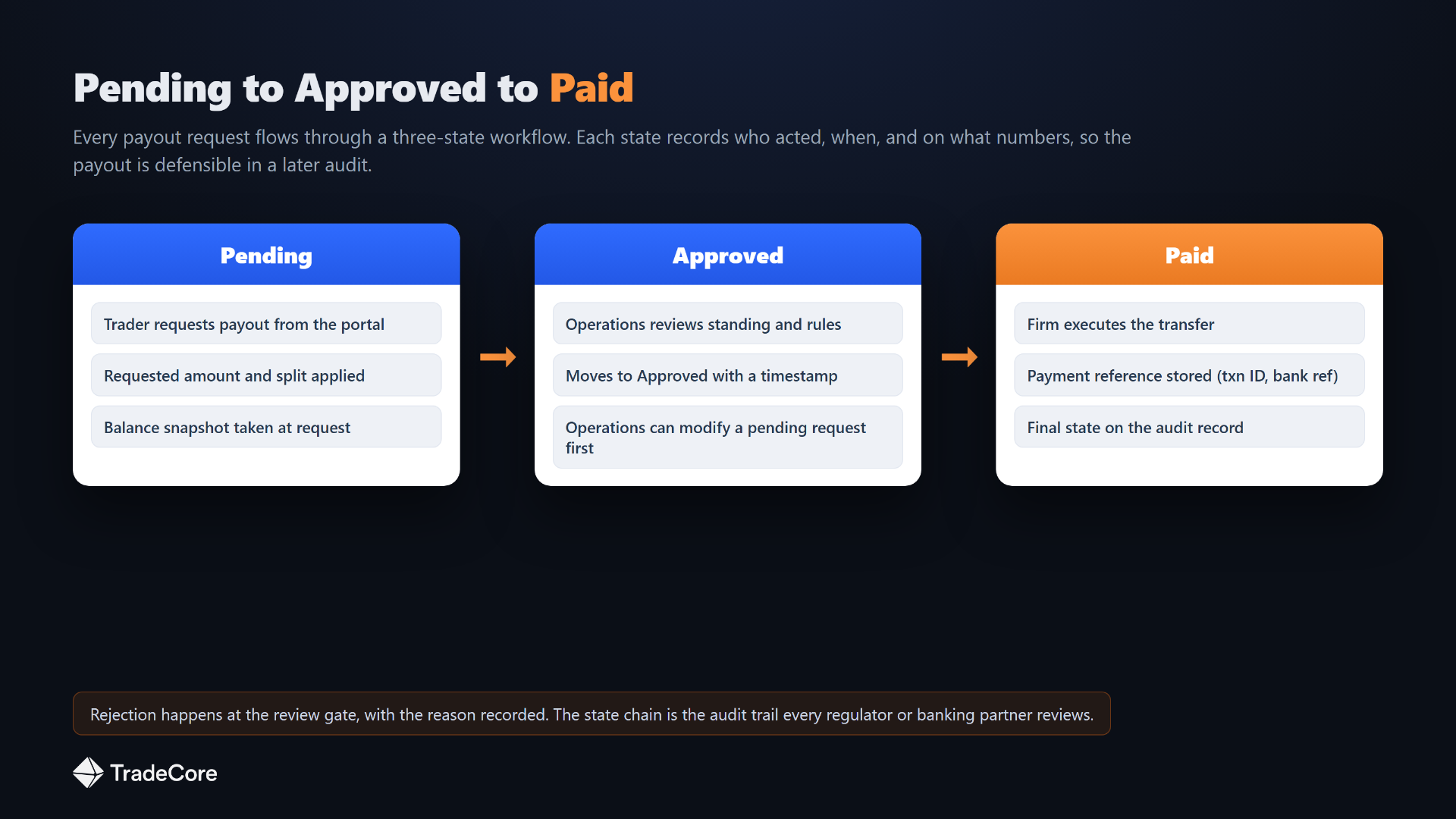
Prop firm payout workflow moving from Pending to Approved to Paid, with a rejection path at the review gate
Rejection happens at the review gate. A Pending payout can be rejected when a problem is found (rule violation discovered, identity verification lapsed, suspicious pattern flagged), and the rejection reason is recorded. Operations can also modify a pending request before approving it. The system tracks the reason for compliance.
The three-state workflow exists because payouts in a prop firm are the moment the firm's money leaves the firm's account. Every payout is a transaction that an auditor, a regulator, or an internal compliance officer can later question. The states create the audit chain: who requested, when, on what balance, approved, when, paid, with what reference.
Why does the balance snapshot matter?
A balance snapshot is the recorded state of the trader's funded account at the moment a payout is requested: balance, peak balance, lifetime P&L and total trades. The snapshot is taken when the trader hits "Request Payout" and stored permanently with the payout record.
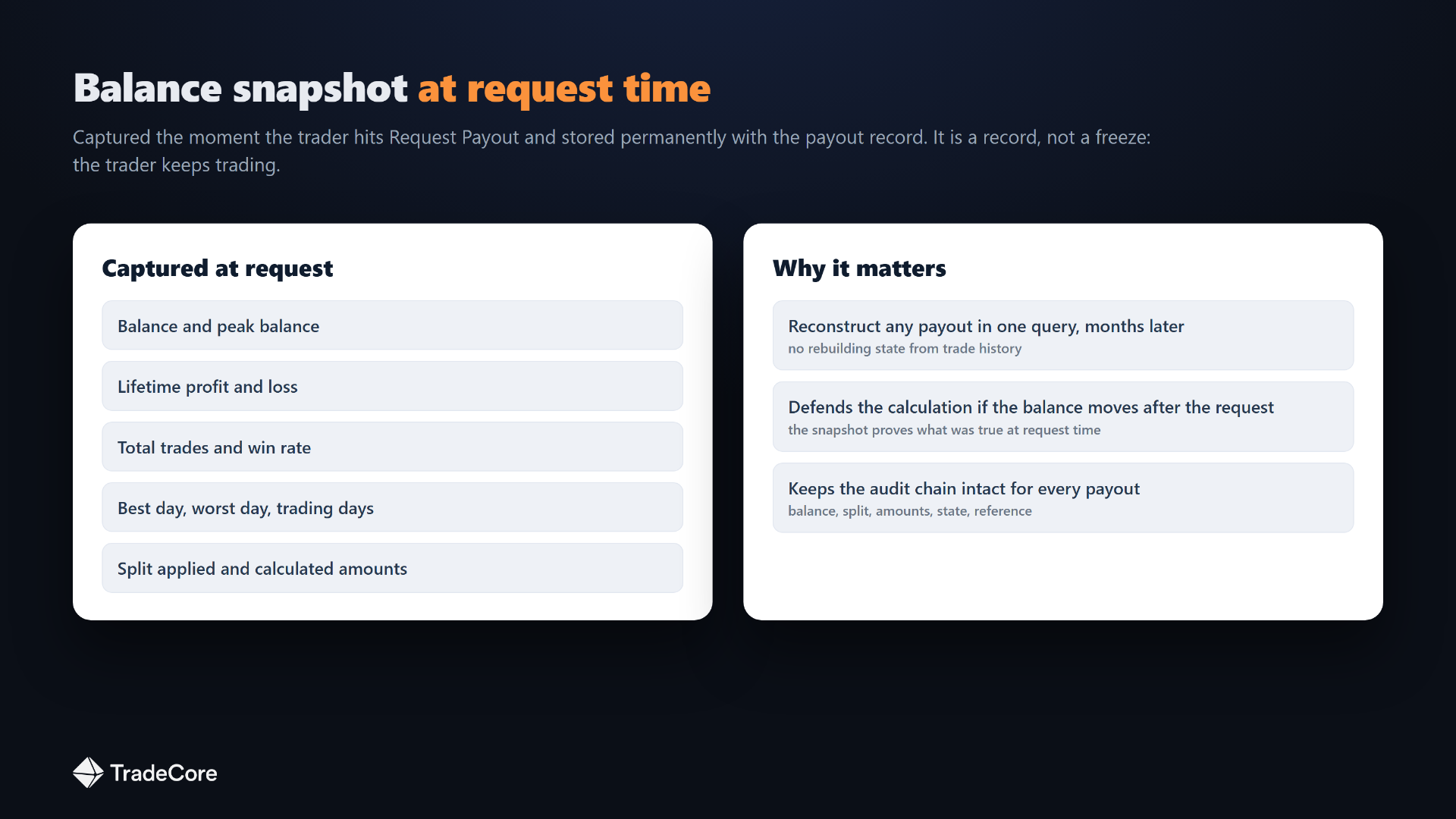
Balance snapshot captured at payout request time recording balance, peak balance, and lifetime profit and loss for audit
The snapshot exists for one reason: defensibility in a later audit. The trader's account balance changes after the request. By the time the payout is reviewed (hours or days later), the balance may have moved up or down. By the time a compliance officer reviews the payout three months later in a regulator's audit, the balance may be unrecognizable.
Without a balance snapshot the audit trail breaks. The compliance officer asks "what was the account balance when this $8,500 payout was approved?" and the answer requires reconstructing the account state from trade history, which is expensive and error-prone. With a balance snapshot the answer is one query: the balance at request time was X, the profit calculated for the payout was Y, the trader's share was Z, and here is the matching record.
The snapshot also defends against a specific class of trader complaints: a trader who requests a payout, watches the balance drop afterwards because of subsequent trades, and claims the payout was calculated incorrectly. The snapshot proves the calculation was correct at the moment of request, regardless of what happened to the balance afterwards.
What does the audit trail include?
A complete payout audit trail captures:
- Trader identity and the funded account.
- Payout request timestamp and the requested amount.
- Balance snapshot at request: balance, peak balance, lifetime P&L, total trades and trading days count.
- Trader/firm split applied at the time of request.
- Calculated trader amount and firm amount.
- Approval step and its timestamp.
- Rejection timestamp and rejection reason (if applicable).
- Payment execution timestamp and payment reference (transaction ID, bank reference, blockchain hash).
- Final state: Paid or Rejected.
The chain is what a regulator or auditor reviews. Each step has a timestamp. Each calculation is reproducible from the snapshot. Each rejection has a reason. The audit-readiness of a prop firm depends on this chain being intact for every payout in the firm's history.
Why does audit matter in a compliance review?
Prop firms operate in a regulatory gray zone in 2026 that is steadily becoming a regulated zone in major jurisdictions. The compliance reviews prop firms face come from three directions:
- Regulators. Where prop firms operate under a financial services license, regulators inspect payout records as part of consumer-protection oversight. The question is whether the firm paid traders consistently with the contractual terms and whether any payouts were rejected without proper grounds.
- Banking partners. Banks providing payment rails to prop firms run periodic reviews. A bank that sees consistent unexplained reversals, ad-hoc balance changes, or audit-trail gaps may de-risk the relationship.
- Internal compliance. Larger prop firms run internal compliance reviews for fraud detection (collusion between trader and operator, manual balance manipulation, payout-without-trade fraud).
Every one of these reviews works the same way: pull a sample of payouts, reconstruct the calculation, verify the audit trail is complete. A prop firm whose audit trails reconstruct cleanly passes the review. A prop firm with gaps in the chain takes weeks to defend each questioned payout. The cost of a weak audit trail is not the technical failure. It is the operations cost of every future audit being slower than it should be.
Does TradeCore handle profit-share payouts?
Yes. BrokerIQ by TradeCore ships a prop-trading payout engine with the full mechanics described above:
- Configurable trader/firm split per challenge template (80/20, 85/15, 90/10, or custom), with optional scaling-tier progression that improves the split as the trader advances through funded-account tiers.
- Payout schedules configurable per template: every 7, 14 or 30 days, or on demand.
- Minimum payout threshold per template, plus a configurable waiting period before a funded trader's first payout.
- Automatic split calculation on every payout: the trader amount is the requested amount multiplied by the trader share percentage, and the firm amount is the requested amount minus the trader amount.
- Pending to Approved to Paid workflow with operations approval, rejection with a recorded reason, and payment-reference tracking.
- Balance snapshot captured at request time for the funded account: the account balance and total profit, fixed on the payout record.
- Full audit trail covering trader identity, request timestamp, snapshot, split, calculated amounts, approval and payment state, payment reference, and final state.
- Per-brand catalogues: each brand runs its own challenge catalogue, with its own templates, splits and schedules.
Want to see the prop-trading payout engine on a live brokerage? Book a demo and we will walk you through challenge templates, splits, schedules, and the payout workflow. You can also review pricing or read more in our guide to the forex CRM for prop-trading firms.
Related guides
Tags
Ready to Get Started?
Discover how TradeCore can help you build and scale your forex brokerage with our comprehensive CRM.