Prop firms make most of their money from challenge fees: traders pay for an evaluation, most do not pass, and the fees pay for the profit-split payouts owed to the few who do. The rest comes from add-ons, resets and the firm's share of funded traders' profits. TradeCore runs both sides of that model for prop firms and FX/CFD brokers.
That makes a prop firm a pricing business as much as a trading one. The firm earns when its challenge prices, its rules and its payout terms agree, and loses when they don't. This guide walks through the model from the firm's side. If you are still setting the business up, start with how to start a prop firm.
Where does a prop firm's revenue come from?
A prop firm has four sources of income. Most firms depend heavily on the first:
| Revenue source | What the trader pays for | When it comes in |
|---|---|---|
| Challenge fees | An evaluation account of a given size, under the firm's rules | At purchase, before any trading |
| Add-ons | Better terms on that challenge: a bigger profit share, more time, more drawdown, fewer trading days | At purchase, with the challenge |
| Resets and repeat purchases | Another attempt after a failed challenge | Every time a trader tries again |
| The firm's profit share | Nothing: it is the firm's cut of what a funded trader makes | On each payout |
Challenge fees
- What the trader pays for
- An evaluation account of a given size, under the firm's rules
- When it comes in
- At purchase, before any trading
Add-ons
- What the trader pays for
- Better terms on that challenge: a bigger profit share, more time, more drawdown, fewer trading days
- When it comes in
- At purchase, with the challenge
Resets and repeat purchases
- What the trader pays for
- Another attempt after a failed challenge
- When it comes in
- Every time a trader tries again
The firm's profit share
- What the trader pays for
- Nothing: it is the firm's cut of what a funded trader makes
- When it comes in
- On each payout
In TradeCore, every purchase and every payout lands on the same client record. The trader buys in the Challenge Store inside the firm's branded portal, choosing add-ons and entering a coupon in the same checkout, and pays through the firm's own payment providers. TradeCore's add-ons cover exactly the four terms in the table: a better profit share, a time extension, more drawdown and fewer trading days.
Why do challenge pricing and pass rates have to agree?
Every challenge sold is a bet the firm prices in advance. The fees from everyone who buys have to cover the payouts to everyone who passes and keeps trading profitably, plus the firm's costs. Three levers decide whether that works:
- Price per account size. What the firm charges for each evaluation.
- The rules. Profit targets, loss limits and drawdown decide how many traders pass. See prop firm challenge rules, explained.
- The payout terms. The profit split, the payout schedule and the limits on when and how much a funded trader can withdraw.
Put simply, fee revenue is challenges sold × price, and payout cost is funded traders × what they withdraw × their share. Loosen the rules or sell a cheaper challenge and more traders reach the second line. Firms that compete on easier rules without repricing are the ones most at risk, because the payout bill arrives months after the fees were spent.
Discounts move the same levers. TradeCore's coupon codes can be a fixed amount or a percentage, carry a validity window, a total usage cap and a per-trader cap, and be limited to named challenge templates, so a promotion cannot quietly discount the whole catalogue.
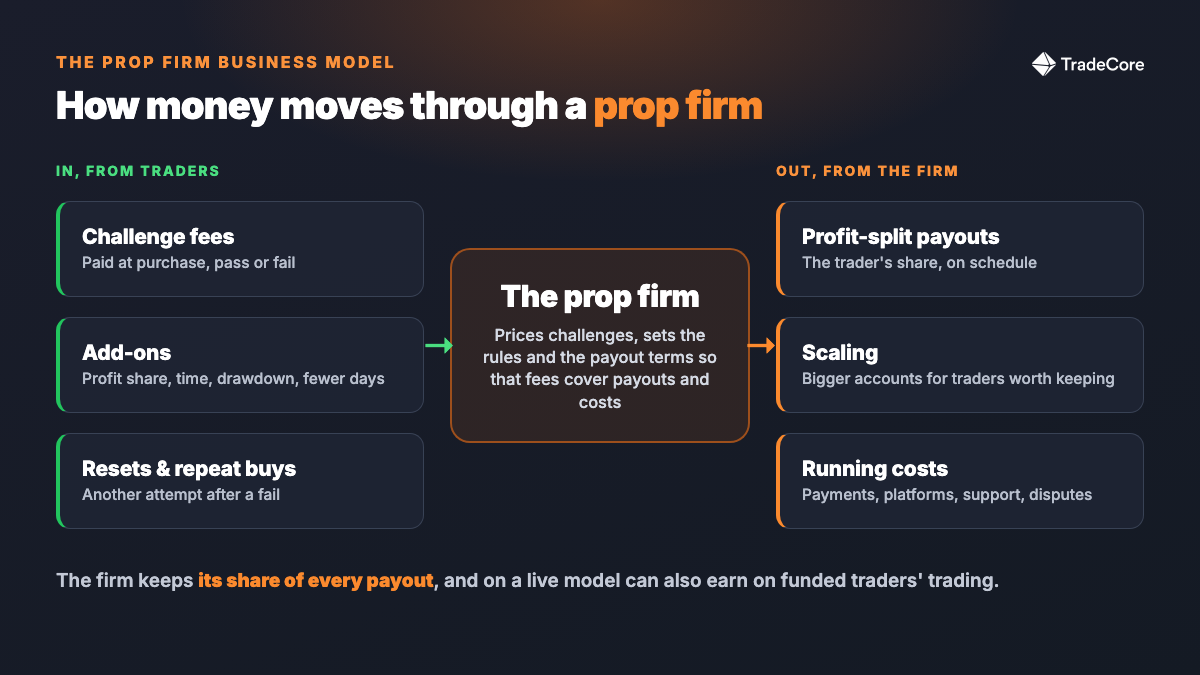
How money moves through a prop firm: challenge fees, add-ons and repeat purchases come in from traders; profit-split payouts, scaling and running costs go out; the firm keeps its share of each payout.
What do payouts cost a prop firm?
Payouts are the firm's largest cost and its strongest trust signal. Traders choose firms on how reliably they pay, so a firm cannot save money by paying slowly. It controls the cost through the terms instead:
- The profit split. The trader's share of each payout; the firm keeps the rest.
- The schedule. How often a funded trader may request a payout.
- The limits. A minimum amount, a minimum share of the balance, and a waiting period before the first request.
In TradeCore, payouts run every 7, 14 or 30 days or on demand, set per template. A template can set a minimum payout amount, a minimum payout percentage of the balance and a first-payout waiting period. Every payout record stores the requested amount, the trader's share, the firm's share, the balance and profit at the moment of the request, and the payment reference once the money moves. For how the split itself works, see what a profit-share payout is.
Simulated vs live funded accounts
What a "funded account" means differs between firms, and it changes where the firm's money comes from:
- Simulated funded accounts. The trader keeps trading on a demo account, and the firm pays their share of the simulated profits from its own revenue. The firm's risk is its payout bill, not market exposure.
- Live funded accounts. The trader's orders reach a real market through a broker. The firm takes market risk on each funded trader and can earn or lose on their trading as well as on fees.
- Hybrid models. Some firms start funded traders on simulated accounts and copy or hedge the consistently profitable ones to a live broker.
The model affects more than the business plan. Payment providers, platform vendors and traders increasingly ask how funded trading is executed, and the answer belongs in the firm's terms in plain words. Take legal advice on how each model is treated in your target markets before you choose.
How do scaling plans help a prop firm make money?
A scaling plan gives the traders worth keeping a bigger account and often a better split. It costs the firm more per payout, but it keeps its best funded traders, and on a live model their trading is where the firm earns. Good scaling rules reward steady results rather than one lucky month.
TradeCore's scaling tiers can require a minimum profit, a minimum number of trading days and a number of consecutive payouts. A scaling check names every requirement the trader has met and every one they have not, next to the numbers it read, so the decision is easy to explain to the trader.
What costs sink prop firms?
Firms rarely fail on one bad trader. They fail on costs that grow quietly with volume:
- Rule checks done by hand. Across hundreds of accounts, manual checks miss some breaches and over-enforce others, and every mistake becomes a dispute or an unearned payout. TradeCore catches rule violations in real time, and on MT5 its own prop plugin enforces the profit target, drawdown, daily loss and time limits on the trading server.
- Disputes. A trader who believes they were failed unfairly costs support time, reputation and sometimes a payment dispute. TradeCore stores every breach as a violation record with the measured value next to the limit it broke, and the trader sees the same record in the portal.
- Repeat sign-ups and abuse. The same person buying under several identities to multiply payouts. TradeCore's CRM scores duplicate clients on phone, name, date of birth and address and sends matches to a review queue.
- Affiliate costs that don't pay back. Partners paid on sales that never become paying traders. TradeCore's IB Suite pays partners Prop Challenge commissions on the challenges their referred clients buy (on Core), on the same records the firm already keeps.
Running the prop firm business model on TradeCore
TradeCore's Prop Trading module covers the whole loop: the Challenge Store with add-ons and coupons, one-, two- and three-step and instant-funding challenges on all eight integrated trading platforms, violation records, funded accounts, scaling tiers and payouts. The trader who buys a challenge is verified, charged, given a trading account, shown their progress and paid on one client record.
Prop Trading's basic edition runs on TradeCore's free plan and on Core: one challenge template on sale at a time, with the MT5 prop plugin, violation review, funding, scaling and payouts working as normal. On the free plan, the firm's team sends each approved payout; on Core, payouts go out automatically through the connected provider. See TradeCore pricing for the full module, and prop firm software for the business side.
Run your prop firm on TradeCore
Start on TradeCore's free plan, or see TradeCore for prop firms.
Frequently Asked Questions
Related guides
Tags
Ready to Get Started?
Discover how TradeCore can help you build and scale your forex brokerage with our comprehensive CRM.