An IB commission structure is the set of rules a forex broker uses to pay its introducing brokers (IBs): what a partner earns on, how each rate is priced, how earnings flow through sub-partners, how tiers lift them and when they are paid. TradeCore's IB Suite runs the whole structure from one deal table, on TradeCore's free plan and on Core.
Introducing brokers are partners who refer traders to a brokerage and earn on what those traders do. If you are new to the model, start with what an IB is in forex. This guide is about the money side: the commission types brokers use, how a multi-level network is priced without overpaying, how matrix pricing and tiers work, and how commissions reach the partner's wallet.
Every figure below is an illustration. Rates, thresholds and bonuses are set by each brokerage; none is a TradeCore default.
What commission types do forex brokers pay IBs?
Most IB programmes combine a handful of payment types. Each answers a different question: are you paying for trading activity, for a new funded client, or for a challenge sale?
- Per-lot rebate. A fixed amount per lot traded by the referred client, the classic IB rebate. It can also be quoted per $100,000 notional or per pip of price movement.
- Spread share. A percentage of the spread value the client's trades generated.
- Commission share. A percentage of the commission the brokerage itself charged on the trade.
- CPA (cost per acquisition). A one-time bounty when a referred client makes a first deposit or a first trade, often with a minimum deposit or minimum lots.
- Prop challenge commission. For brokers that also run prop trading: the partner earns on the challenges their referred clients buy.
In TradeCore's IB Suite these sit in three commission categories: Trade-Based, CPA and Prop Challenge. A Trade-Based rate can carry all three trading components at once (an amount by volume, a share of the spread and a share of the brokerage's own commission), so a hybrid rate is one cell, not three separate deals.
IB vs affiliate vs hybrid: what is the difference?
The partner's label follows from how they are paid. In the IB Suite a partner's type is derived from the deals that govern it, so nobody maintains it by hand:
| Partner type | Paid on | Typical fit |
|---|---|---|
| IB | Trading activity (a Trade-Based deal) | Partners who keep a relationship with the traders they bring |
| Affiliate | Acquisition only (a CPA deal) | Comparison sites, media buyers, lead agencies |
| Hybrid | Both (Trade-Based and CPA deals) | Partners who refer and keep driving activity |
IB
- Paid on
- Trading activity (a Trade-Based deal)
- Typical fit
- Partners who keep a relationship with the traders they bring
Affiliate
- Paid on
- Acquisition only (a CPA deal)
- Typical fit
- Comparison sites, media buyers, lead agencies
Hybrid
- Paid on
- Both (Trade-Based and CPA deals)
- Typical fit
- Partners who refer and keep driving activity
How do multi-level IB commissions work?
A multi-level IB network lets a partner recruit sub-partners, who recruit their own. A main IB earns on its sub-IBs' clients as well as its own; each sub-IB earns on its own branch. The design question is how to pay every level without the total running away from you.
TradeCore answers it with one table per deal: partner levels down the rows, sources across the columns, and an absolute keep in every cell. Each level earns the keep in its own row, so the brokerage's cost on a trade is the sum of the cells on that chain, and nothing depends on percentages of percentages. The IB Suite supports unlimited partner levels.
- One assignment prices a branch. The deepest deal assigned on a referral chain prices that whole branch, so one deal on a main IB covers every sub-partner beneath it.
- A budget cap per source. A column can carry a ceiling on what the brokerage spends on one trade across the whole chain, however the cells are filled.
- Self-management. A parent partner can move part of its own keep down to a sub-partner without changing the brokerage's cost.
- Deals don't shift mid-cycle. A live deal is frozen. New terms archive it and take effect at the next cycle boundary, and no commission already earned is ever recomputed.
Example: a deal pays the main IB $4 a lot and its sub-IB $3 a lot on Forex Majors. A Forex Majors lot traded by the sub-IB's client costs the brokerage $7, every time, and the main IB can choose to hand $1 of its own $4 down to the sub-IB to help it grow.
What are matrix commissions?
A matrix commission prices the same deal differently by source. Instead of one rate for every trade, each column is a source of flow (an instrument group such as Forex Majors, Metals or Crypto, an execution group, or a single symbol, trading group or account type) and each cell has its own rate. Matrix is not a separate commission type: it is how a Trade-Based deal is built. A flat per-lot deal is simply a matrix with the same amount in every cell.
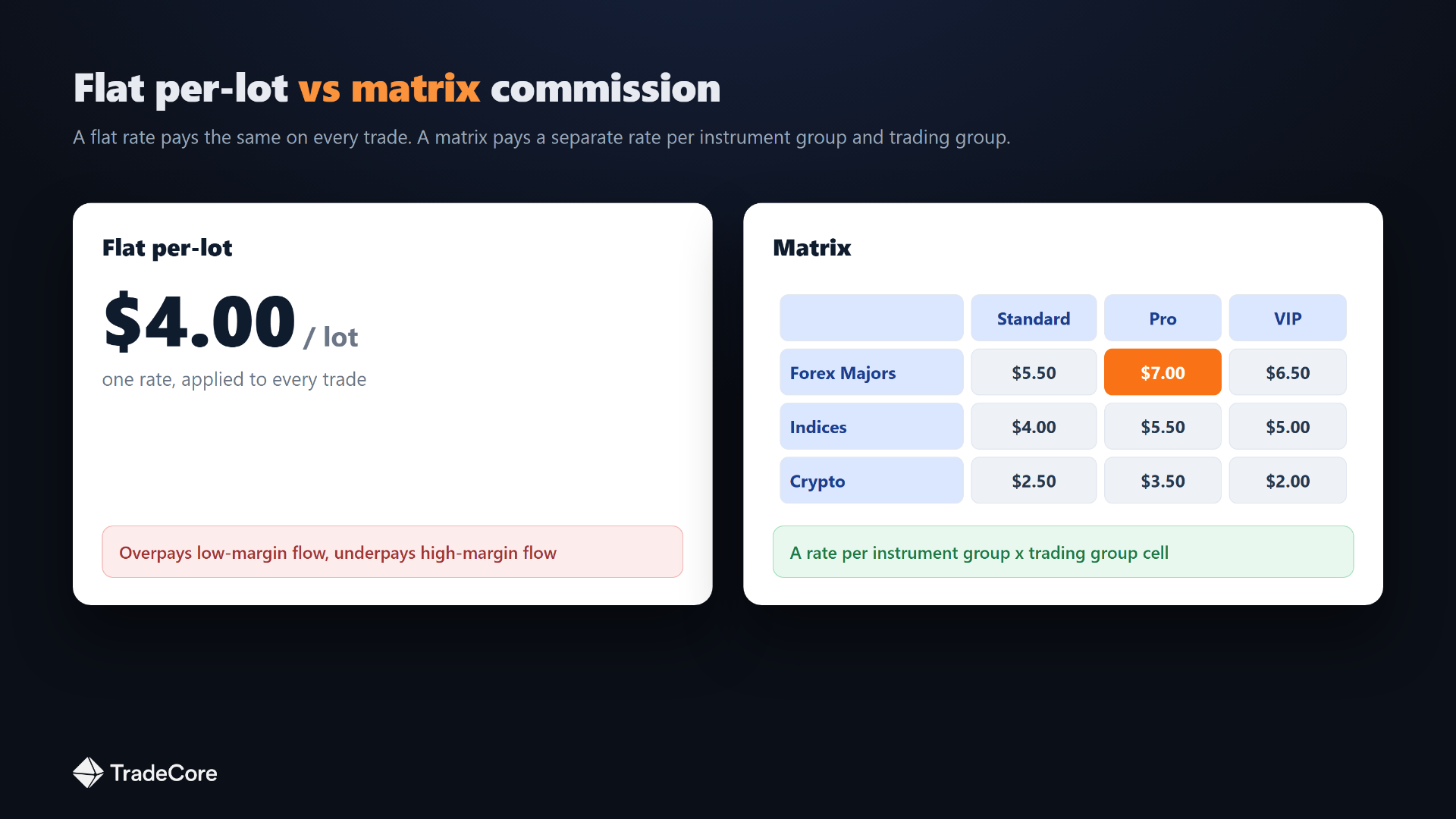
Illustrative comparison of a flat per-lot IB rate and a matrix priced per instrument group and trading group. Not a screenshot of the live product.
Brokers use a matrix when their margin differs by asset class or client segment, or to pay a top partner more in the cells it actually fills. A practical way to choose:
| Partner or flow profile | Deal that fits |
|---|---|
| Long-tail partners, low volume each | A Trade-Based deal at one flat per-lot rate |
| Acquisition agencies, comparison sites | CPA |
| Partners who refer and drive activity | Trade-Based and CPA together (a hybrid partner) |
| Top partners with flow concentrated in a few instruments | A Trade-Based deal priced per cell |
| Books where margin varies widely by instrument | A Trade-Based deal priced per cell |
Long-tail partners, low volume each
- Deal that fits
- A Trade-Based deal at one flat per-lot rate
Acquisition agencies, comparison sites
- Deal that fits
- CPA
Partners who refer and drive activity
- Deal that fits
- Trade-Based and CPA together (a hybrid partner)
Top partners with flow concentrated in a few instruments
- Deal that fits
- A Trade-Based deal priced per cell
Books where margin varies widely by instrument
- Deal that fits
- A Trade-Based deal priced per cell
In TradeCore the columns come from the brokerage's own instrument and execution group catalogues, so a deal prices against the symbols and groups its trading platforms report. Pricing by instrument and execution group is part of Core.
Which trades earn an IB commission?
Qualification rules stop a programme paying for flow it does not want. In the IB Suite a deal can require a minimum trade duration, a minimum lot size and a minimum pip movement, combined with AND or OR. Demo trades never move a partner number.
Every qualifying trade writes rows to an append-only commission ledger with the full calculation behind them. A trade that earns nothing is recorded with one of seven named reasons, such as no rate for that source, instead of disappearing, which is what settles partner disputes quickly.
How do IB commission tiers work?
A tier programme pays better partners more. Partners climb a ladder on their network's results and earn a tier bonus on top of every commission while they hold the tier. The deal stays the contract; the tier is a performance overlay, so the ladder can change without rewriting a single deal.
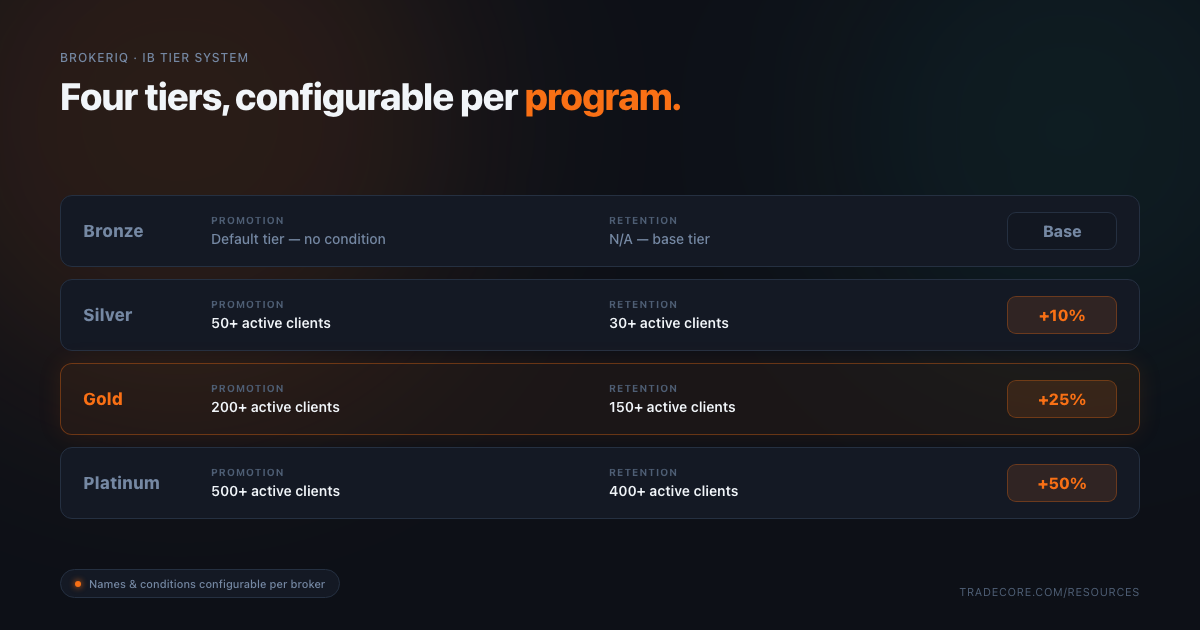
Example IB tier ladder with four tiers, each with promotion conditions, a retention threshold and a commission bonus. Names and figures are illustrative.
Example ladder: many brokers name tiers after metals. Bronze pays the base rate; Silver at 50 active clients adds 10%; Gold at 200 adds 25%; Platinum at 500 adds 50%. The names, the number of tiers, every threshold and every bonus are the brokerage's own choice.
- Promotion and retention are separate. Each is set on four measures (traded lots, FTD count, active clients and total deposits) with AND/OR. Retention sits lower than promotion, so a partner on the line does not flicker between tiers.
- A grace period softens a demotion. A partner who dips below retention gets a set number of days to recover before dropping.
- Evaluated daily. A partner who earns Gold today is paid Gold rates from today, without a monthly manual review.
- Flat or percentage bonus. A tier adds a percentage of each commission or a fixed amount per commission.
- Progressive or accumulative. Progressive applies the new tier to future commissions; accumulative applies it across the commissions already earned in the cycle.
- Every change is recorded. Each promotion, demotion, reset or manual change keeps the metrics that caused it and who made it.
The tier programme is part of Core. An IB promotion in TradeCore is exactly this: a partner climbing a tier.
When are IB commissions paid?
Commissions settle into the partner's commission wallet, one per partner per currency, and the partner withdraws through the same withdrawal rails as any other wallet. In TradeCore the payout schedule is set on the partner plan, on TradeCore's free plan and on Core:
- Instant. With no payment cycle, each commission credits the partner's wallet as it accrues. Brokers use it for trusted partners by putting them on an instant-paying plan.
- Daily, weekly or monthly. Commissions gather over the cycle and settle on the day the plan sets.
- Custom. A cycle every set number of days.
A plan can make a payout conditional on the partner qualifying, on minimum FTDs, minimum deposits, minimum active clients or minimum traded lots. On a cycle, each partner's payout is decided individually: approve, hold, roll over into the next cycle, or adjust with a manual entry. Settlement is multi-currency, at the rate frozen when the commission accrued.
What does an IB need to see?
A commission structure only builds trust if partners can check it. The IB Suite gives every partner the Partner Hub, a self-service portal under the brokerage's brand: earnings, clients, tracking links with their own funnels, the sub-partner network, the wallet, withdrawals and reports, in the portal's languages. A partner can hide its name from its downline. See the Partner Hub tour for each area.
Running an IB programme on TradeCore
TradeCore's IB Suite runs on TradeCore's free plan with unlimited introducing brokers, one referral link each, a per-lot Trade-Based commission, one sub-level, one partner plan, one deal, unlimited commission records, payouts instantly or on a cycle, and the Partner Hub without marketing materials.
Core runs the full IB Suite: all three commission categories, unlimited partner plans, deals, tracking links and partner levels, plus the tier programme, instrument and execution group pricing, and partner marketing materials. See TradeCore pricing for the plans side by side.
Run your IB programme on TradeCore
Start on TradeCore's free plan, or book a demo to see a deal priced against your own instrument groups.
Frequently Asked Questions
Related guides
Tags
Ready to Get Started?
Discover how TradeCore can help you build and scale your forex brokerage with our comprehensive CRM.