
IB stands for Introducing Broker: a person, agency or sub-broker who refers traders to a forex brokerage and earns a commission on what those traders do. An IB system is the part of a forex CRM that manages every partner who refers clients to a broker, how those partners are tracked, how their commissions are calculated, and how they get paid.
A serious IB system in a forex CRM, such as the IB Suite in TradeCore's BrokerIQ, handles four things continuously: it attributes every new client to the partner who referred them, it calculates the commission earned on every trade or acquisition, it manages a hierarchy of partners and sub-partners with the commissions flowing correctly through every level, and it pays the partners out on a configurable schedule with an approval gate.
What are the types of partners an IB system manages?
Three types of partners cover almost every real-world structure:
- IB (Introducing Broker). Refers traders to the broker, earns commission based on trading activity (usually per lot traded).
- Affiliate. Refers traders, earns on acquisition (a fixed amount per client who reaches a configured condition, usually first deposit).
- Hybrid. Both at the same time: a per-lot commission plus a fixed amount per acquisition.
Most forex brokers run a mix. Trading-focused partners (financial educators, signal providers, regional offices) tend to be per-lot IBs. Marketing-focused partners (paid acquisition agencies, comparison sites) tend to be affiliates. Top-tier partners often run hybrid models.
How do IB commissions work?
The three core models in 2026:
- Per lot. The simplest: every closed trade is counted in lots and multiplied by a rate. A 5-lot trade at $2/lot earns the IB $10. Rates are typically configurable per instrument group (Forex Majors at one rate, indices at another) and per client trading group.
- CPA (Cost Per Acquisition). A fixed amount when a referred client meets a configured condition, usually first deposit at or above a minimum. Deduplicated so the same client only triggers the CPA once per partner.
- Hybrid. CPA on acquisition plus per-lot on every subsequent trade. The two rules coexist on the same partner record.
Some platforms additionally support matrix commission rates: a two-axis table with partner levels down one axis and sources, such as instrument groups or account groups, across the other, with a configurable rate per cell. Used by brokers with complex books to set precise per-cell pricing. Every commission type, multi-level pricing, tiers and payout schedules are covered in the guide to IB commission structures.
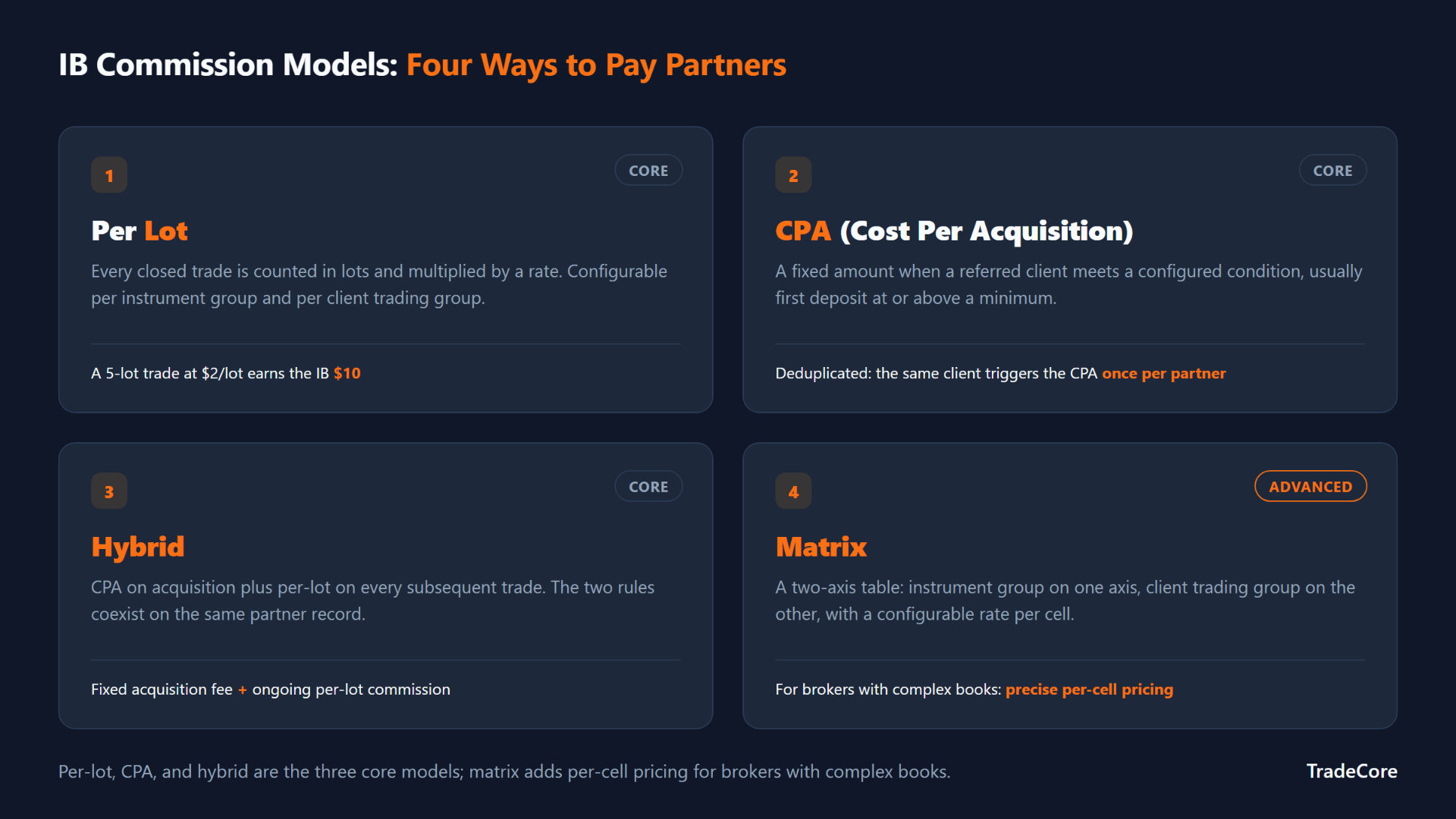
IB Commission Models: four ways to pay partners — Per Lot, CPA, Hybrid, and Matrix
What is the IB hierarchy and why does depth matter?
An IB hierarchy is the tree of partners and sub-partners under the broker. A Main IB can have sub-partners, who can have sub-partners of their own, and so on. Most forex CRMs cap the hierarchy at three or five levels. Platforms that support unlimited partner levels grow with the network without forcing the broker to flatten or pay outside the platform.

IB Hierarchy: BrokerIQ supports unlimited tier depth while most forex CRMs cap at three to five levels
On a well-built IB system, two mechanics decide how commissions flow through the tree:
- An absolute keep per level. One deal table sets what each level keeps on each source, so every partner earns from its own row rather than from a share someone above passes down.
- Self-management. A parent partner can fund a sub-partner, or a cashback carve for its own client, from its own keep. The partner decides how generous to be downstream; the broker’s cost on the trade does not move.
A serious IB system supports both, and lets the broker give one branch its own terms without rebuilding the tree. In BrokerIQ’s IB Suite, the deepest deal assignment on a chain prices that whole branch.
What is an IB tier system?
A tier system rewards higher-performing partners with better commission rates. An example tier programme (the brokerage names the tiers and sets every threshold and bonus):
- Bronze — Default. Base rate.
- Silver — 50+ active clients. +10% on commissions.
- Gold — 200+ active clients. +25% on commissions.
- Platinum — 500+ active clients. +50% on commissions.
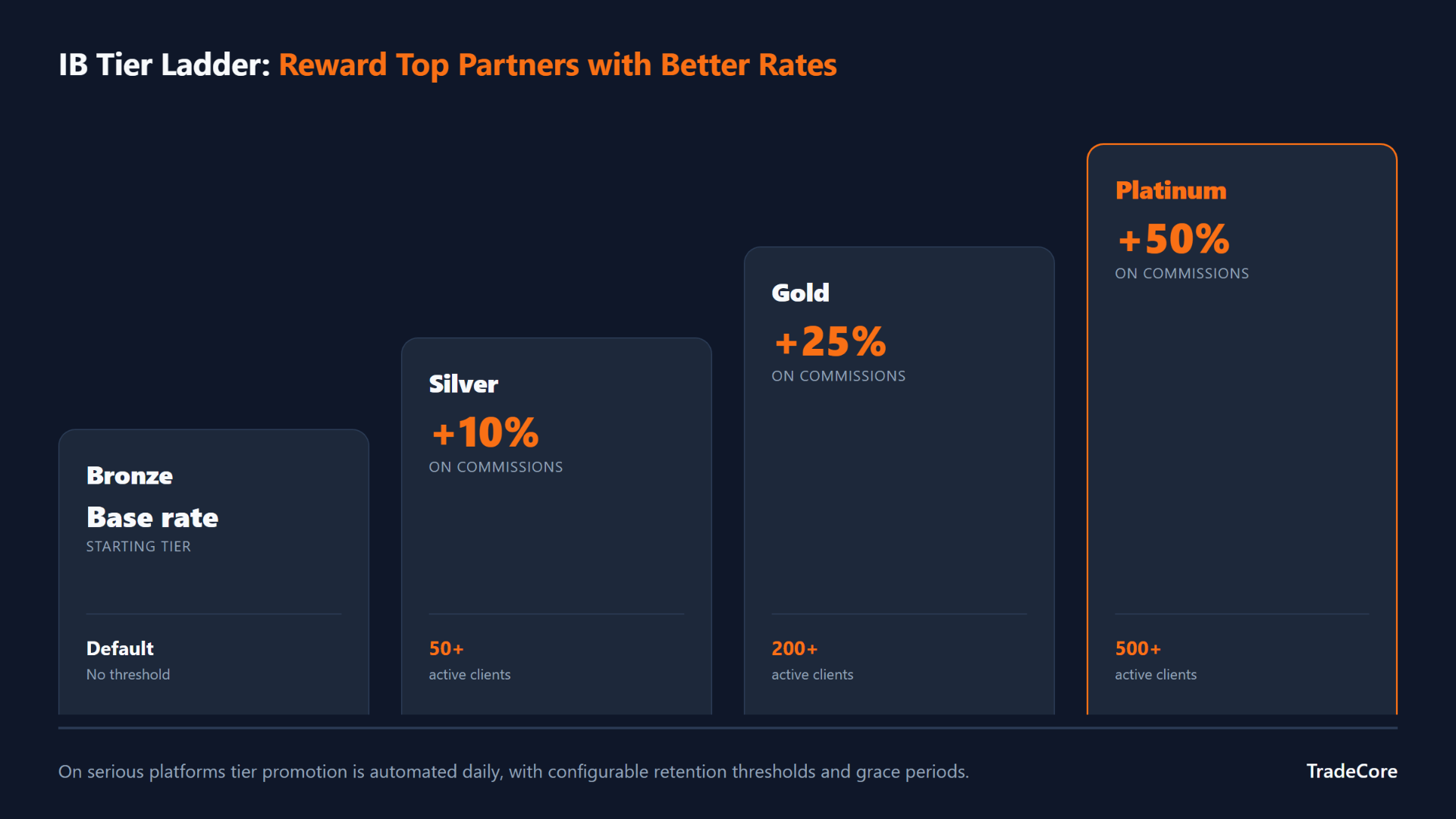
IB Tier Ladder: Bronze, Silver, Gold, and Platinum tiers reward top partners with better commission rates
Promotion conditions are configurable (active clients, total deposits, lots traded, or combinations). Retention thresholds set the minimum activity to stay in the tier. Grace periods set how long an underperforming partner has to recover before they drop. On serious platforms, tier evaluation is automated daily; on weaker ones, it is a manual ops job.
How are IB payouts processed?
Commissions accumulate during a configurable cycle (daily, weekly, monthly, or custom). When the cycle ends, the system processes accumulated commissions per partner. An approval workflow lets ops approve, hold, roll over or adjust each partner’s payout individually, without affecting other partners in the same cycle. Once approved, commissions move to the IB’s wallet, from which they can request a withdrawal.
Payouts can also be instant: a partner plan with no cycle credits each commission to the partner’s wallet as it accrues, available for withdrawal without waiting. Brokers use it as a retention lever by putting trusted partners on an instant-paying plan. The full mechanics are in IB commission structures: tiers, matrix pricing and payouts.
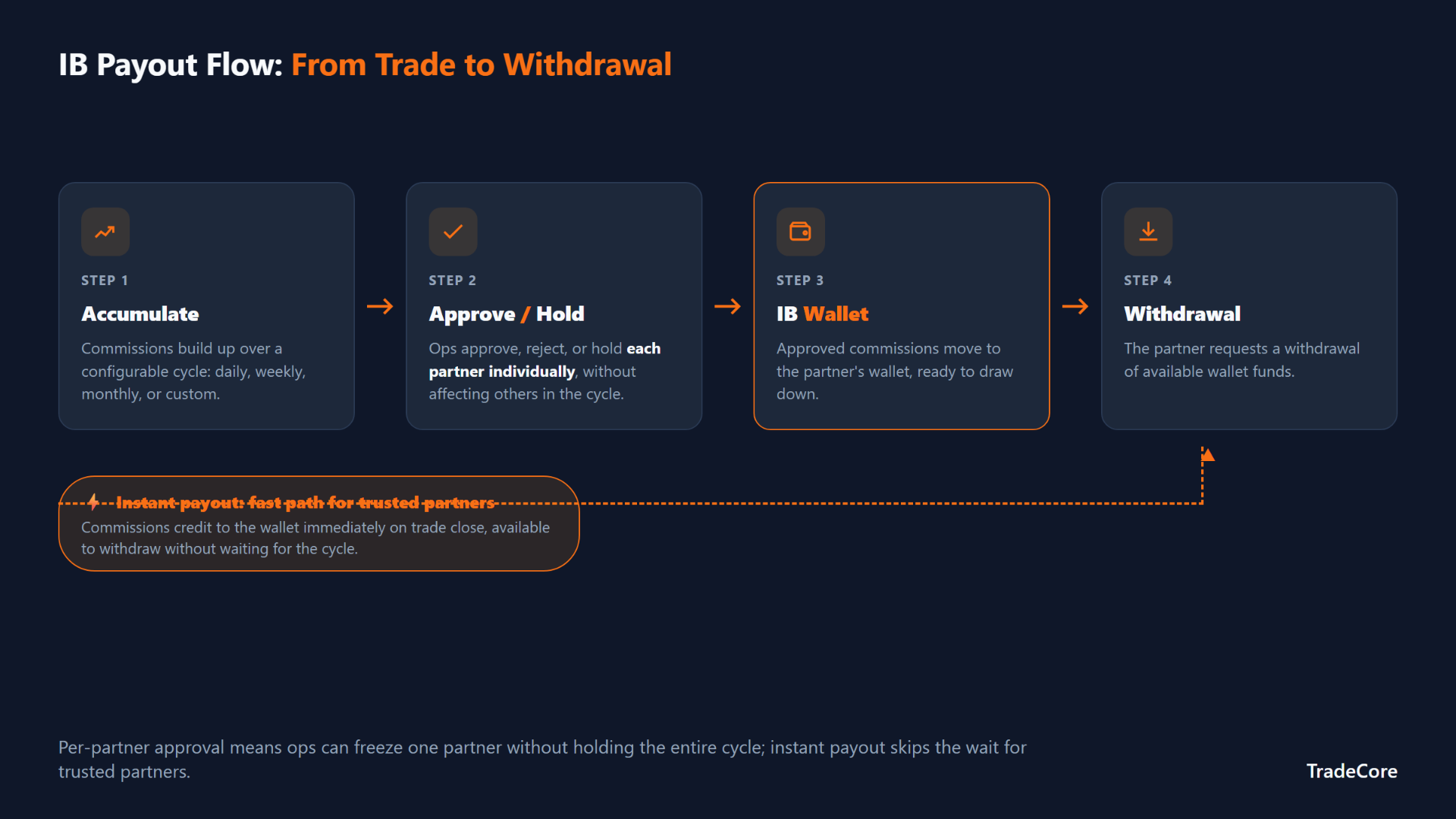
IB Payout Flow: from trade close to withdrawal, with instant-payout fast path for trusted partners
What is a Partner Hub?
The Partner Hub is the partner-side portal where IBs and affiliates log in to manage their own activity. A well-designed Partner Hub is fully branded to the broker (logo, colours, custom domain) and lets the partner see earnings, browse referred clients, check commission history, create and manage tracking links, view their sub-partner network as a tree, download marketing materials, and request withdrawals.
A self-service Partner Hub is the difference between an IB programme that scales without hiring ops and one where every commission question becomes an ops ticket.
What should brokers evaluate when choosing an IB system?
- Tier depth. Is the hierarchy capped or unlimited?
- Commission models. Per-lot, CPA, hybrid, and matrix supported side by side?
- Level pricing. Does every level earn its own keep from one deal table, and can a partner fund its sub-partners from its own keep?
- Tier automation. Are promotions and drops automated, with configurable retention and grace?
- Partner Hub. Branded to the broker (custom domain), self-service across all common partner actions?
- Tracking links. Can a single IB have multiple tracking links, each with its own attribution and its own funnel?
- Payout workflow. Approve, hold or roll over per partner, not per cycle?
- Instant payouts. Can a partner plan pay commissions as they accrue, for the partners you trust most?
For an in-depth take on each of the eight points above, see eight IB-system features most forex CRMs do not have.
Does TradeCore have an IB system?
Yes. BrokerIQ is TradeCore’s modular CRM and back-office product line for FX/CFD brokers, and its IB Suite is a full IB system: unlimited partner levels, three commission categories (Trade-Based, CPA and Prop Challenge) priced by one deal table with matrix commission rates, self-management so a partner can fund its own sub-partners, automated tier promotion with grace periods, a branded Partner Hub, per-channel tracking links with their own funnels, per-partner payout decisions, and payouts on a daily, weekly, monthly or custom cycle or instantly, set per partner plan. The tier programme is part of Core.
To see the IB system running on a live brokerage, book a demo, or run the IB Suite on TradeCore's free plan.
Frequently asked questions
Related guides
Tags
Ready to Get Started?
Discover how TradeCore can help you build and scale your forex brokerage with our comprehensive CRM.