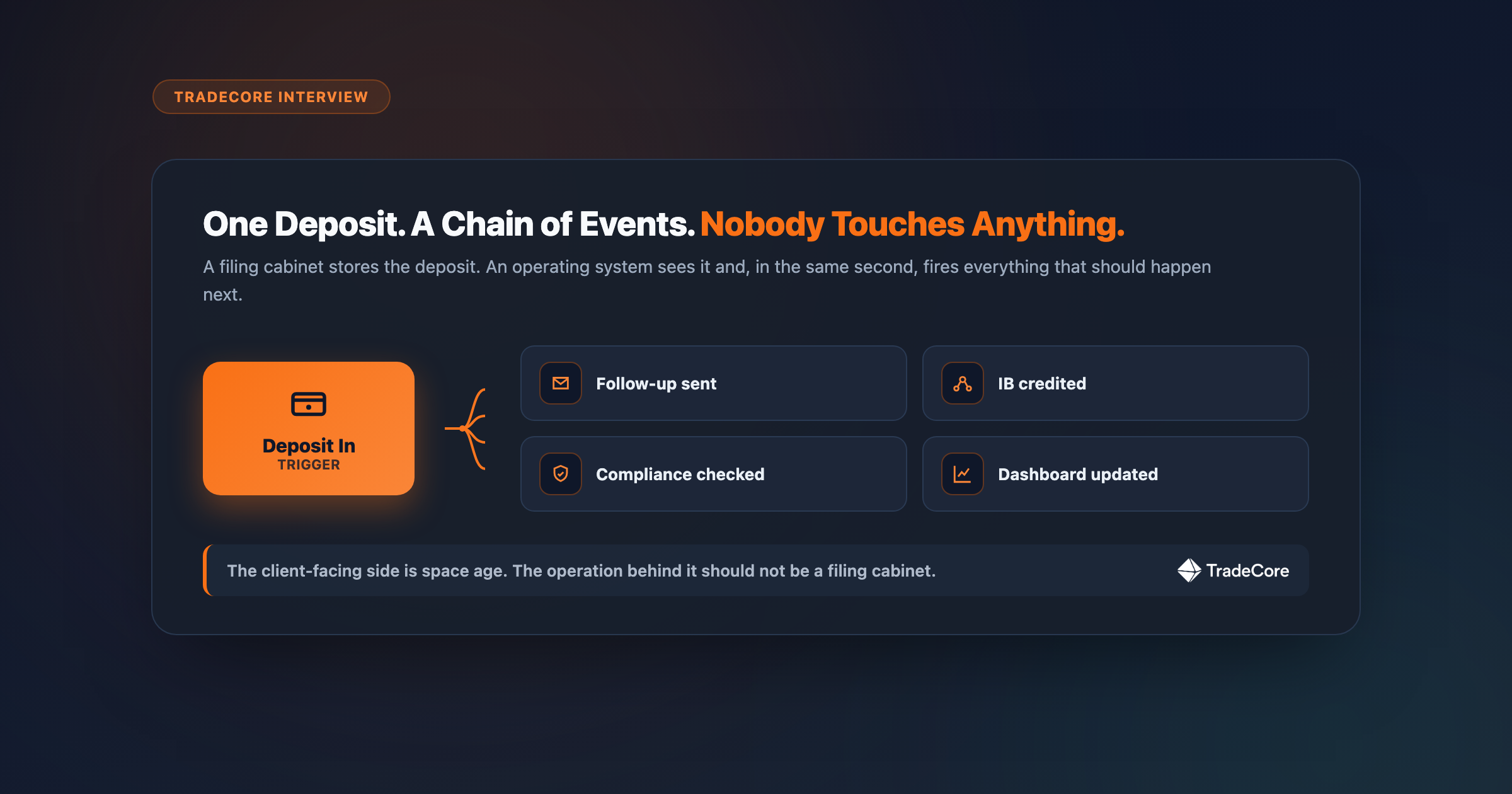
TradeInformer sat down with our own Bojan Jovic to talk about a problem he sees in almost every brokerage he meets: the client-facing side is space age, but the operation behind it still runs on spreadsheets. It's a conversation we wanted to share here, because it gets to the heart of how we think about BrokerIQ — and why we build it the way we do.
Over the course of the interview, Bojan laid out what he calls the industry's “spreadsheet mentality”, why brokers are still paying skilled people to do work a machine should have owned years ago, why we position BrokerIQ as an operating system rather than a CRM, and why the operational decisions a broker makes today will decide how well they can adopt AI tomorrow. Here's how the conversation went.
The question we get asked first: what's actually wrong?
TradeInformer opened with the obvious one — working with brokerages every day, what does Bojan see as the biggest problem in how they operate in 2026? His answer was a phrase he uses a lot internally: a spreadsheet mentality.
“I have seen brokers running eight-figure books whose entire operation lives in systems that are essentially Excel-like,” he said, “where institutional knowledge is an Excel formula one employee understands, and everyone prays she never resigns. It is 2026. The tools to kill almost every spreadsheet in a brokerage have existed for years. They survive out of habit, and habit is the most expensive software a broker will ever run.”
The client-facing side is space age. The operation behind it is a filing cabinet.
Bojan Jovic, TradeCore
What gets him, he told them, is the contrast: the same brokers who obsess over shaving milliseconds for their traders will run the back office like it's 2009. “That gap bleeds money every day, but nobody calculates it, because the cost hides inside salaries and looks like people doing their jobs.”
So we were asked: what should brokers stop doing by hand?
Everything that can be automated, Bojan said — and he offered the test we apply ourselves. “If the work is ‘when X happens, do Y’, a human should not be doing it. You are paying a salary for an if-statement.”
He didn't soften it. “Walk into an average brokerage and you will find talented, expensive people sending reminders to clients. Sending reminders. A machine does that better, at three in the morning, without forgetting, and it never asks for a raise.” The people should be on the work that actually needs them — closing the high-value client, negotiating the IB deal, making the compliance judgement call that protects the licence. “Ironically, that is often the work they never get to, because they are too busy being the automation their software should have been.”
When TradeInformer raised the objection every broker raises — our process is too specific to automate — Bojan pushed straight back. Our automation engine covers more than 200 event triggers across 17 areas of the brokerage, and operations teams build the rules themselves — no code, and no ticket to us. “We have never met the ‘too specific’ process that did not fit. The mentality is too comfortable. That is all.”
event triggers across 17 areas of the brokerage — rules your ops team builds itself
brokerages and prop firms running on one platform — no two configured alike
Why we call it an operating system, not a CRM
They asked the fair question: beyond the label, where does “operating system” actually hit a broker's bottom line? Bojan's framing is one we stand behind. “Most CRMs in this industry are glorified filing cabinets. They are organised records of things your team still has to do manually. An operating system sees the deposit and, in the same second, fires the follow-up, credits the IB, runs the compliance check and updates the dashboard. Nobody touches anything.”
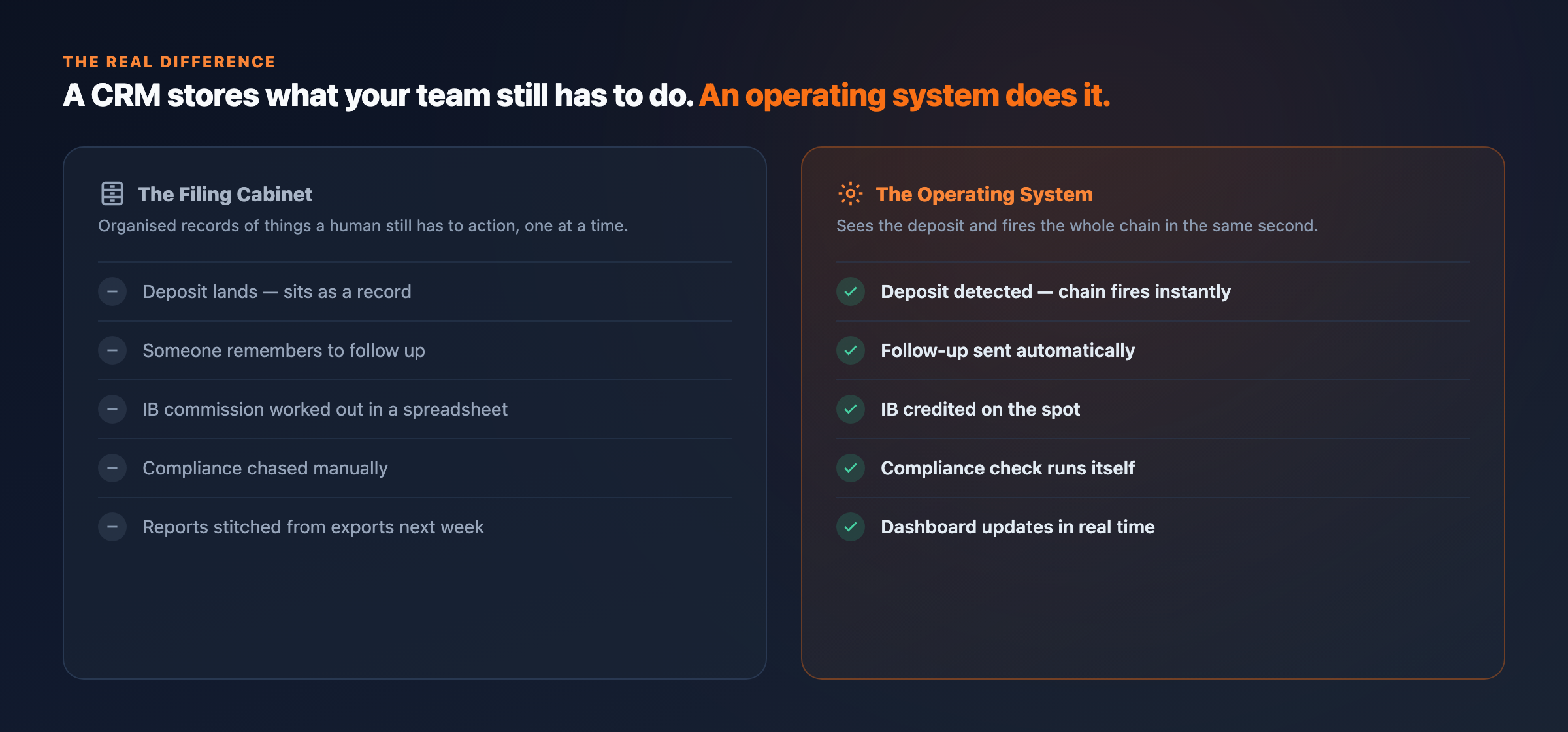
A CRM stores what your team still has to do; an operating system does it — filing cabinet vs operating system compared step by step.
He walked them through the cost. Start with payroll: a serious share of the wage bill in many brokerages goes toward humans effectively being middleware between systems. “A manual operation scales linearly. Double your clients and eventually you have to double your back office. An automated brokerage can double its clients without doubling the team. That is margin, and margin decides who survives when spreads compress.”
But the bigger cost, he said, is the money you never see. “The trader who went quiet and nobody noticed for three weeks. The IB who was paid late because somebody was working from a spreadsheet and then left with their network. Those things never appear as a cost line. They show up as growth that mysteriously does not materialise, and the broker blames marketing. In reality, it was response time.”
The modular approach — and why we sell it that way
TradeInformer asked how our modular approach works in practice. Bojan explained the principle we start every engagement with: keep your existing technology, and take the individual pieces you need from us. “You can keep the CRM you run today and plug in the piece that hurts most. Take the IB system. Take SupportIQ. Take the automation engine and feed it from your existing stack. The enemy is manual work, and I do not care which route you use to start killing it.”
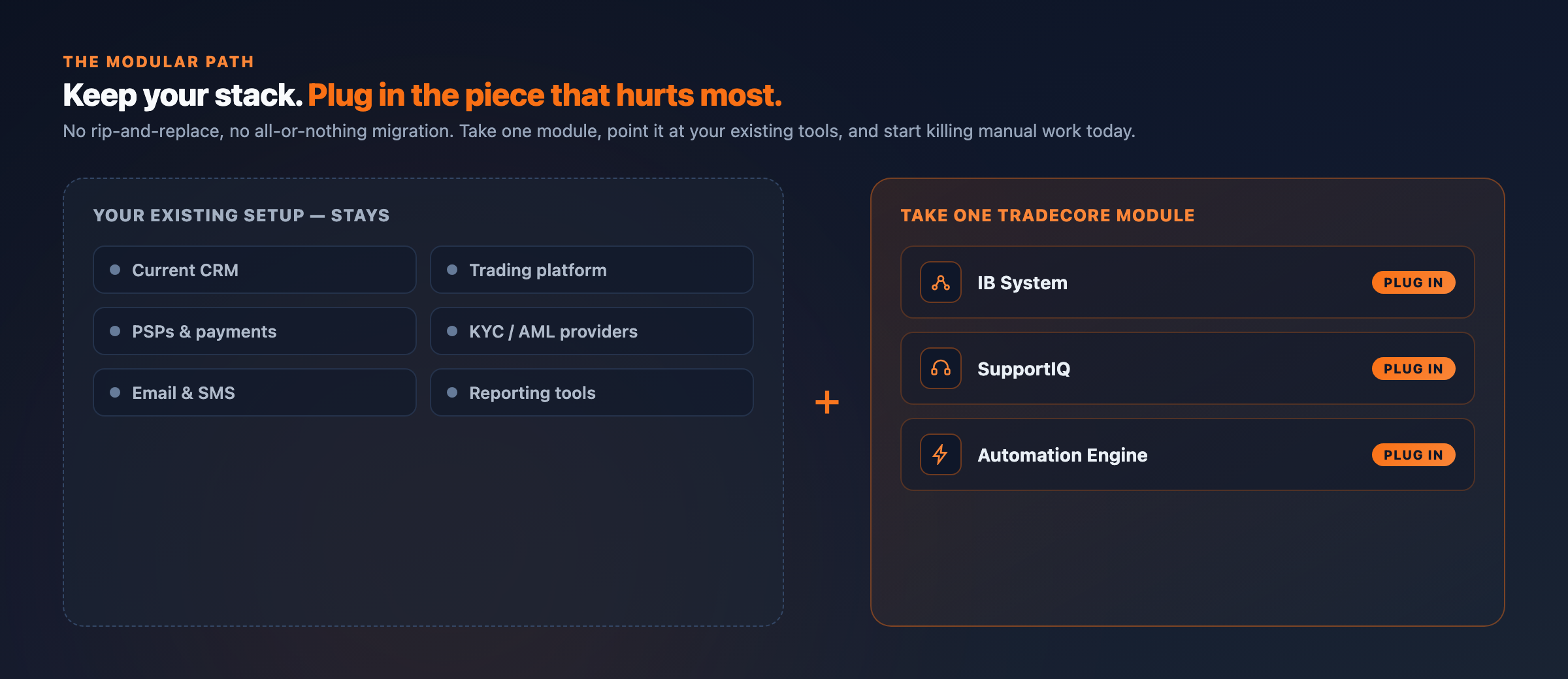
Keep your stack, plug in the piece that hurts most — keep your CRM, trading platform, PSPs, KYC, email and reporting, and add one TradeCore module.
He was pointed about the alternative. “Most vendors demand the opposite — they want you to rip everything out, migrate on day one, all or nothing. Migration is one of the scariest projects in a broker's life, and vendors weaponise that fear to force the big contract. I think that is lazy selling, and it keeps brokers in their spreadsheets for another three years.” And there's a discipline in it for us, he added: “Selling one module at a time keeps us sharp. Every module has to beat a specialist on its own merits. There is no bundle to hide behind.”
On retention: three clients, three journeys
Asked to make it concrete, Bojan took retention. “A client who deposited but never traded, somebody trading every day, and somebody who suddenly goes quiet after six months are three completely different situations. They should trigger three completely different journeys.” Our automations let a broker build those responses with no coding or technical knowledge, he said, off the client lifecycle states BrokerIQ already tracks — where most firms still fall back on cookie-cutter marketing that doesn't fit the behaviour of the actual user. “The response should happen automatically, within minutes, and be sized to the value and behaviour of that client. This is so simple to do, and brokers are leaving money on the table by not doing it.”
How well does broker software bend to the broker?
They asked how well the industry's software actually adapts to a broker's own processes. “Badly,” Bojan said, “and it matters far more than companies realise. Your process is part of your edge. It is one of the reasons you win against the broker next door. Software that forces you into its workflow is deleting your competitive advantage and calling it best practice.”
When a vendor says “that is not how our system works,” what they really mean is “your business should change so our roadmap does not have to.”
Bojan Jovic, TradeCore
We run more than 100 brokerages and prop firms on one platform, he noted, and no two are configured alike. The deeper problem is who controls the changes. “In much of this industry, every workflow change means a ticket to the vendor, a quote and weeks of waiting. Speed is one of the biggest advantages a smaller broker has, and if your vendor is slow, that kills your edge. If your team needs a developer to change an email trigger, your vendor has failed you — and they may be perfectly comfortable with that, because your helplessness becomes their services revenue.”
Looking ahead: automated versus manual
On what separates the brokers who thrive from the ones who struggle over the next few years, Bojan's answer was technology — specifically what it lets you do with AI. “The divide will not be big versus small. It will be automated versus manual.” Every AI application that matters in this industry — risk signals, retention scoring, intelligent support, personalised communication — needs clean, unified, machine-readable operations underneath it. “If you are still running manual input and disparate processes, you will lose. Someone else will have a unified, machine-readable system, which they can use AI to operate more efficiently.”
The same shift rewrites team size, he said. “Margins will keep compressing. The winners will be lean teams where the platform handles routine execution and people handle judgement, relationships and strategy. One side can add clients without adding cost, and it's obvious who wins that in the end. Some brokerages today are structured almost like manual-labour operations with a trading licence attached. The next few years are going to make that increasingly difficult to sustain.”
The advice we'd give a founder starting today
TradeInformer closed by asking what would be non-negotiable if Bojan were building a brokerage today. His answer put the company ahead of the software. “Software is what the vendor built yesterday. The company is what is going to happen to you for the next five years.” Ask what the technology underneath is — a modern stack, or a fifteen-year-old codebase wearing a new interface? Ask how often they ship. “Ask them what they released last month. Specifically. The vendor's pace becomes your pace.”
Then, in the demo, he said, look for one thing above all: does the platform automate, or does it just store data? “Have them show you a real deposit triggering a real chain of events. Message sent. Status changed. IB credited. Compliance flagged. Nobody touching anything. Then have your own operations person build an automation rule live, right there in the demo. If either request turns into ‘our professional services team can arrange that’, you have learned everything you need to know.”
The rest is diligence founders skip too often, he added — pricing that doesn't feed on your growth, integrations that already exist, and evidence of who's already running on the platform at scale. “You never want to be the client on whom a vendor learns. Get the company right and most technology mistakes are recoverable. Get it wrong and you will not build a brokerage.”
Run the test Bojan describes.
Book a demo and we'll show you a real deposit firing a real chain of events — then let your own ops person build an automation rule, live.
Frequently Asked Questions
This conversation was originally conducted and published by TradeInformer. Recapped here with light edits for length.
Related guides
Tags
Ready to Get Started?
Discover how TradeCore can help you build and scale your forex brokerage with our comprehensive CRM.