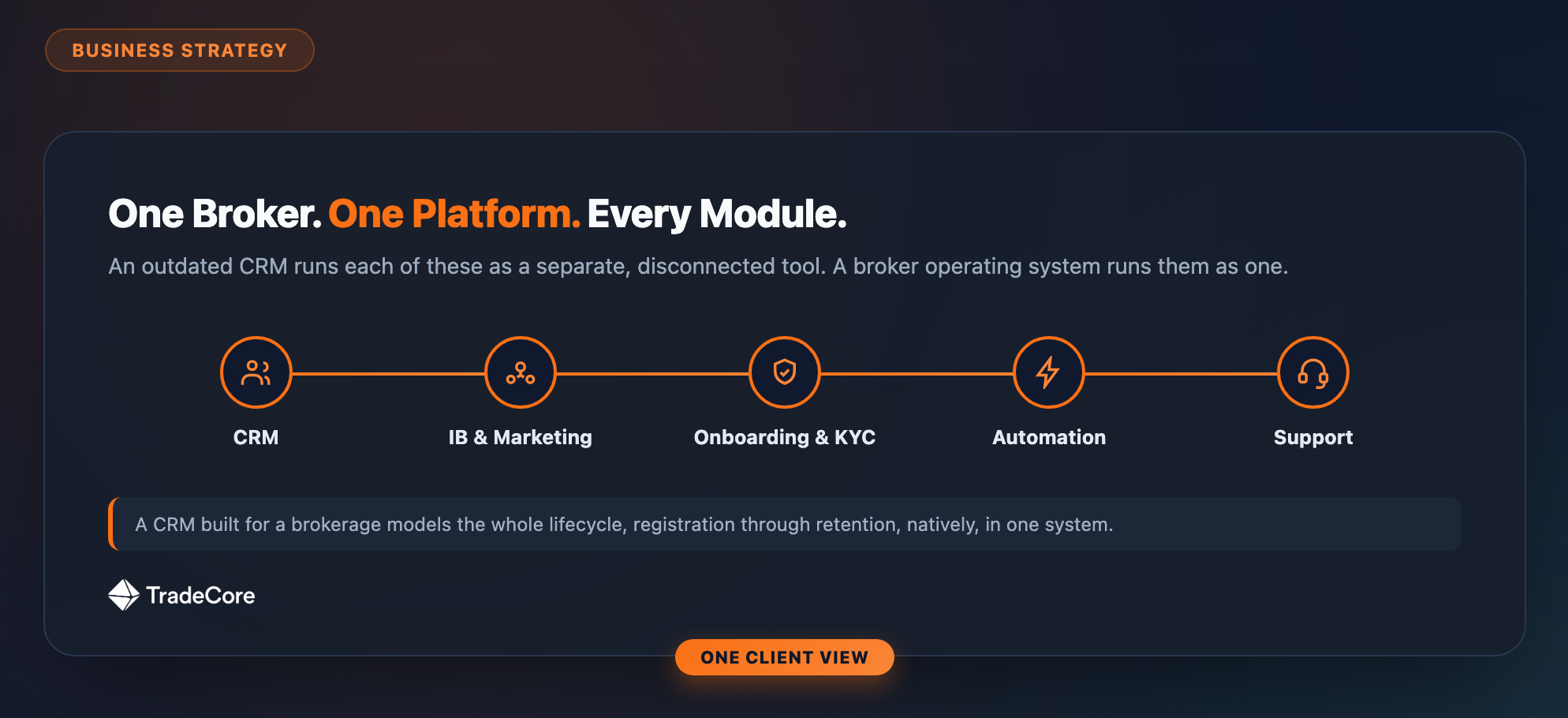
Every brokerage eventually hits the same wall. Marketing is generating leads, sales headcount is growing, and the trading platform is stable, yet growth stalls anyway. Deposits plateau, agents burn out on admin work, and management can't get a straight answer to a simple question: what is actually happening across our client base right now?
Almost every time, the root cause traces back to the same piece of infrastructure: the CRM. Not because brokerages chose badly, but because most CRMs were never built for a brokerage in the first place. They were built to manage generic "contacts," bolted onto a trading platform, and left to accumulate workarounds for years. The result isn't a system that runs the business: it's a system the business has to work around.
Here are eight ways an outdated CRM quietly caps how big a brokerage can get, and why the CRM should be treated as core infrastructure rather than an afterthought.
1. Sales teams waste time on manual work instead of closing deposits
In a brokerage built on an outdated CRM, agents spend a large share of their day on tasks that have nothing to do with selling: updating lead statuses by hand, copying data between screens, writing the same follow-up email for the tenth time that day, and manually chasing leads through a spreadsheet-like pipeline.
Every one of those minutes is a minute not spent on the phone with a client who is ready to fund an account. Sales is a numbers game measured in conversations and closed deposits, and a CRM that forces agents to act as data-entry clerks directly suppresses both. The brokerages that scale sales output aren't the ones that hire the most agents; they're the ones whose CRM removes the busywork so agents can spend their time where it actually converts.
2. Leads fall through the cracks
Without intelligent lead routing, prioritisation, and automated follow-up sequences, a lead list is just a list, not a pipeline. High-value prospects sit in a queue next to low-intent sign-ups, and whoever gets to them first (or doesn't) determines the outcome, not who they actually are.
A modern brokerage CRM should score and route leads automatically: sending high-intent, high-value prospects to the right desk or agent instantly, triggering follow-ups the moment a lead goes quiet, and re-engaging dormant prospects without anyone having to remember to. When that layer is missing, sales teams end up working the wrong leads simply because those are the ones sitting at the top of an unsorted list, while the prospects worth the most attention go cold.
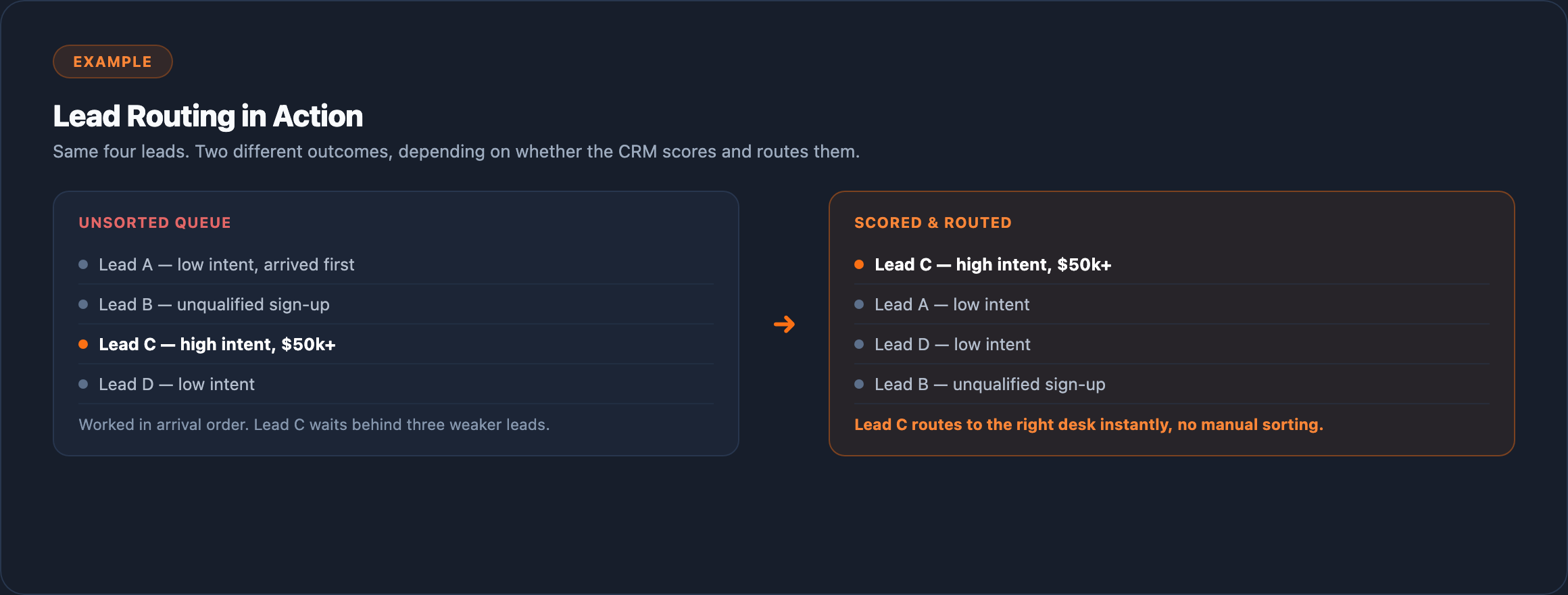
Lead routing in action: the same four leads worked in unsorted arrival order versus scored and routed by value, sending the high-intent $50k+ lead to the right desk first.
3. The CRM doesn't understand the brokerage lifecycle
A generic CRM sees a "lead," a "contact," or a "deal." A brokerage doesn't operate in deals: it operates in a lifecycle: registration → KYC → first-time deposit (FTD) → trading activity → retention → reactivation. Each stage has its own risks, triggers, and required actions, and a CRM that can't natively model that journey forces teams to fake it with tags, custom fields, and manual tracking.
When the CRM doesn't understand the lifecycle, nobody has a reliable view of where a client actually is. Compliance can't easily confirm KYC status against activity. Sales can't tell an FTD from a re-deposit. Retention can't identify a client drifting from "active trader" to "dormant" until it's too late to matter. The lifecycle is the business: a CRM that doesn't model it is managing something other than the brokerage.
4. Brokerages operate with disconnected systems
CRM, trading platform, KYC/AML providers, payment service providers, email, SMS, and IB systems frequently operate as separate silos, each with its own login, its own data, and its own partial view of the client. The result is fragmented data and no single source of truth: a client's trading activity lives in one system, their deposit history in another, their compliance status in a third, and their communication history in a fourth.
Without integration, teams spend time reconciling data between systems instead of acting on it, and errors creep in every time information has to be manually transferred from one platform to another. A brokerage running on disconnected systems isn't really running one operation: it's running several, held together by exported spreadsheets and good intentions.
5. Management cannot see what is actually happening
Which desk converts best? Which country or campaign generates the most FTDs? Which agent actually drives deposits, not just activity? These should be simple questions with real-time answers. In a brokerage held together by disconnected systems and manual processes, they usually aren't.
Outdated reporting means management is looking at last week's numbers, stitched together from multiple exports, by the time a decision needs to be made. That turns leadership reactive instead of proactive: reacting to a bad month instead of spotting the dip in week one, doubling down on a campaign that's underperforming for another two weeks, or missing the exact recipe of desk, geography, and offer that's quietly outperforming everything else. Without a live, unified view of performance, growth decisions become guesses dressed up as strategy.
6. Automation is treated as a luxury
Modern brokerages cannot manually manage every onboarding reminder, every KYC follow-up, every dormant client check-in, and every retention trigger, not at any real scale. Yet in a brokerage still running on a legacy CRM, automation is often treated as a nice-to-have rather than core infrastructure, which means most of that work still happens manually, one client at a time.
That has a direct, compounding cost: without automation, the only way to scale is to keep hiring more people to do more manual work. Headcount grows in lockstep with client volume instead of growing slower than it, and the brokerage never gets the operating leverage that should come with scale. Automation isn't about replacing the sales and retention teams: it's about making sure every client gets the right nudge at the right moment without a human having to remember to send it.
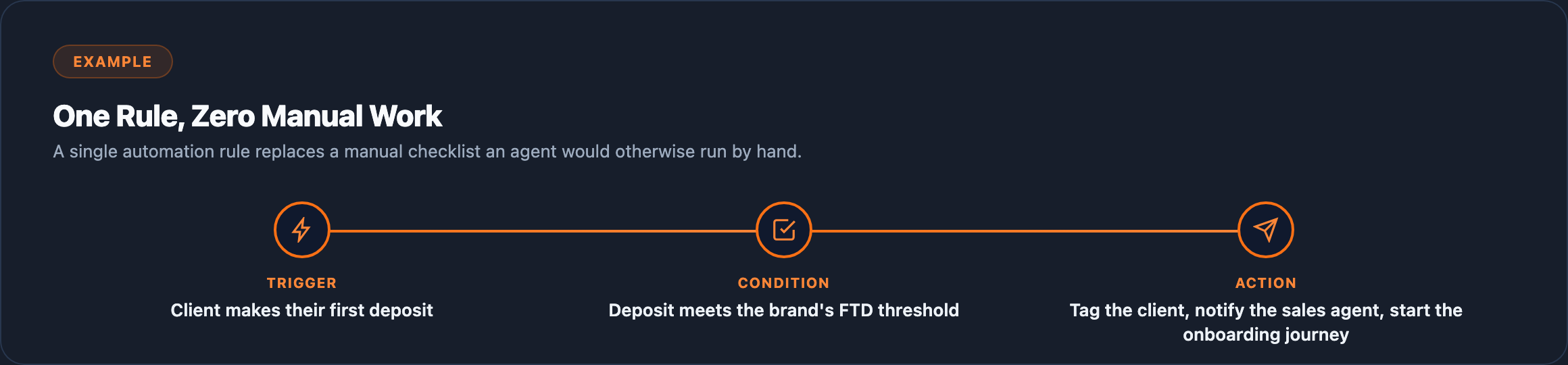
One automation rule, zero manual work: a first-deposit trigger, an FTD-threshold condition, and an action that tags the client, notifies the sales agent, and starts the onboarding journey.
7. IB and partner management becomes chaotic
As a brokerage grows its introducing broker and affiliate network, the complexity grows with it: commission structures, multi-level hierarchies, attribution across campaigns and sub-IBs, and performance tracking all become significantly harder to manage by hand. A CRM that treats IBs as an afterthought usually means commissions calculated in spreadsheets, disputes over attribution, and partners who have no self-service visibility into their own performance.
That chaos has a direct cost: partners are one of the most efficient acquisition channels a brokerage has, but a broker that can't pay them accurately, on time, and transparently will struggle to retain its best-performing IBs, the same ones a competitor with better infrastructure would be glad to take off their hands.
8. The CRM limits growth instead of enabling it
This is the point that matters most. A brokerage can invest heavily in marketing, build out a larger sales team, and push into new markets, but if the operational infrastructure underneath all of it can't scale, that investment doesn't turn into revenue. It turns into more problems: more manual work per new hire, more leads falling through the cracks, more disconnected data for management to untangle, more chaos in the partner network.
Growth is supposed to make a brokerage more efficient: more volume spread over the same fixed costs. An outdated CRM inverts that. Every new market, every new desk, every new IB adds friction instead of leverage, because the system underneath was never built to absorb it. At that point, the CRM isn't a neutral piece of software sitting in the background: it's the ceiling on how big the brokerage can get.
The bottom line
None of these eight problems are really separate issues. They're symptoms of the same underlying cause: a CRM built for generic sales pipelines, asked to run a brokerage instead. Brokerages don't need another contact database: they need a system that understands the registration-to-retention lifecycle, connects trading, payments, KYC, and communication into one client view, automates the manual work that doesn't need a human, and gives management a live picture of what's actually driving performance.
That's the gap platforms like BrokerIQ are built to close: a CRM designed around how a brokerage actually operates, not around how a generic sales team does.
If any of these eight problems sound familiar, it's worth asking a blunt question: is your CRM helping your brokerage scale, or is it quietly the reason growth feels harder than it should?
See a CRM built for a brokerage
Book a demo to see how a purpose-built brokerage CRM handles lead routing, lifecycle automation, IB management, and reporting in one platform.
Frequently Asked Questions
Related guides
Tags
Ready to Get Started?
Discover how TradeCore can help you build and scale your forex brokerage with our comprehensive CRM.