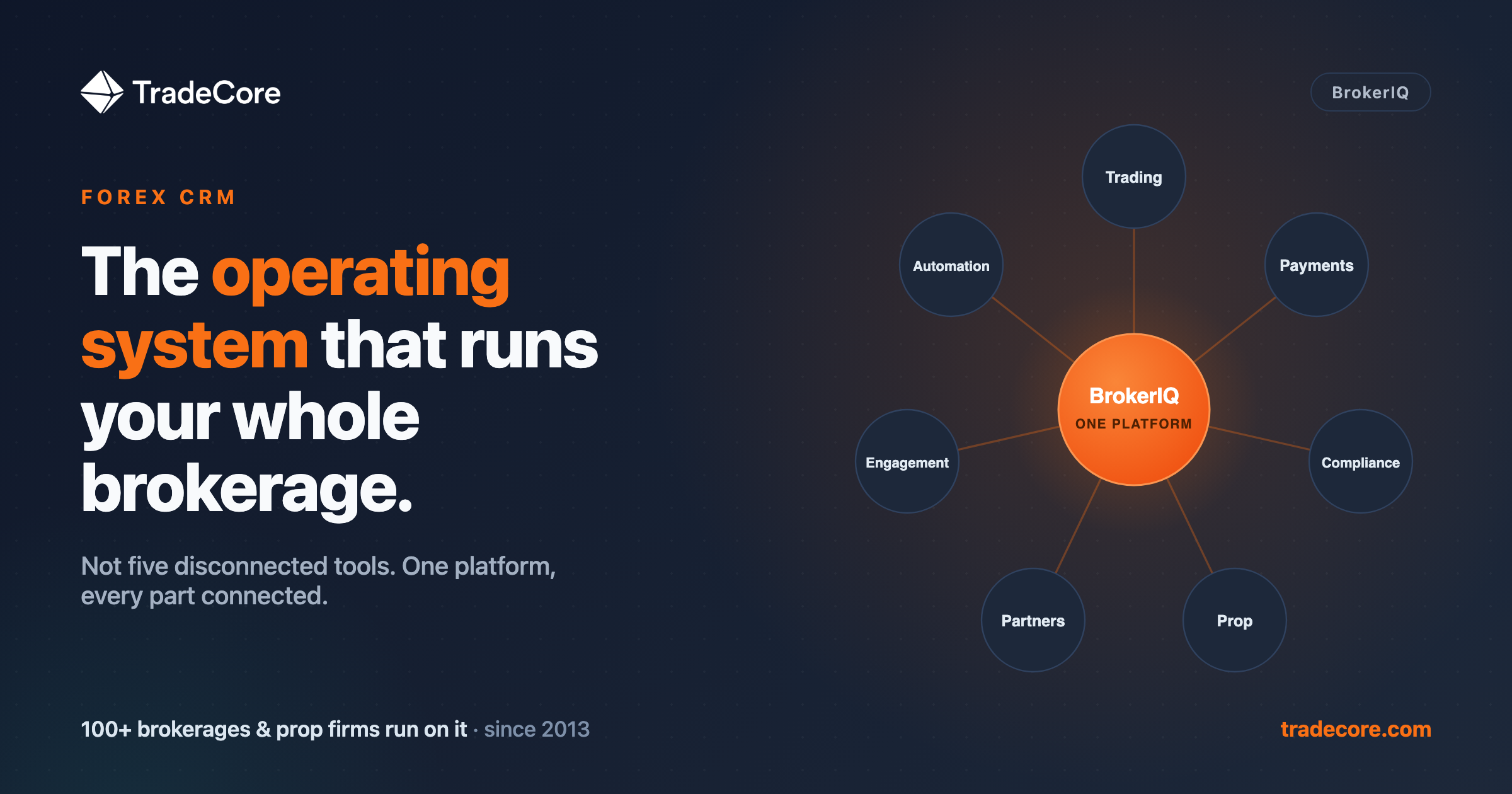
A forex CRM is the software an FX/CFD brokerage runs its client business on: client records, onboarding and KYC, deposits and withdrawals, trading accounts on MT4, MT5 and other platforms, introducing brokers and marketing, in one system. TradeCore's BrokerIQ is a forex CRM and back-office platform used by 100+ brokerages.
This guide covers what a forex CRM does, what belongs inside one, how it differs from a back office and a trading platform, how brokerages deploy and migrate, and what a forex CRM costs. Each section uses TradeCore's BrokerIQ as the worked example. If you only need the short definition, read what is a broker CRM.
What is a forex CRM?
A forex CRM, also called a forex broker CRM or a CRM for forex brokers, is a client relationship management system built for brokerages that offer forex and CFD trading. It holds one record per client and connects that record to everything the brokerage does with the client: the signup flow, identity verification, the payment providers, the trading accounts on the trading platform, the introducing broker who referred the client, and every message sent.
The client record is the point. A sales agent, a compliance officer and a payments operator open the same client and see the same deposits, documents, trades and tickets, so nobody works from an export. In TradeCore, that record is the data core every BrokerIQ module reads from and writes to when it runs natively.
How is a forex CRM different from a generic CRM?
A generic CRM tracks leads, deals and emails. It has no idea what a trading account, a withdrawal approval or an IB commission is, so a brokerage running one builds those connections itself or runs them in separate tools. A forex CRM ships with them: native trading platform integrations, payment providers, KYC providers, partner commissions and the regulatory rules of each jurisdiction.
TradeCore connects 8 trading platforms, 100+ payment providers with 300+ payment methods and 5 KYC providers out of the box, and runs 200+ integrations in total. Those are configured in the back office, not built as projects.
What's inside a forex CRM?
A complete forex CRM covers ten areas of the brokerage. Here is what each one does, and how TradeCore's BrokerIQ handles it.
Client records and the client profile
The client profile is where the brokerage's teams meet. In TradeCore it has 7 tab groups and 17 tabs, from Overview and Activity Stream to Profile & KYC, Financials, Trading, CRM & Support and Marketing, with fields edited inline and a client health score built from deposit activity, account usage, engagement and verification. Duplicate detection scores phone, name, date of birth and address, and sends likely duplicates to a review queue with a governed merge. Dynamic Segments keep named client cohorts up to date on their own. See the forex broker CRM core.
Onboarding and KYC
Onboarding decides how many registrations become funded clients. TradeCore's signup flow builder sets custom fields, conditional logic, suitability scoring and verification requirements per signup type, brand and jurisdiction, and a client who stops halfway resumes where they left off. Identity verification runs through 5 KYC providers, SumSub, Onfido, Cellbunq, GBG and ComplyAdvantage, with conditional routing between them, and compliance rules for CySEC, FCA, ASIC and other regulators are managed per jurisdiction from one dashboard. Corporate clients onboard with their beneficiaries and UBOs. See TradeCore's broker compliance and KYC.
Payments and wallets
Money is where a forex CRM proves itself. TradeCore connects 100+ payment providers and 300+ payment methods across 50+ currencies, including Stripe, Skrill, Neteller, PayPal, Praxis, CoinsBuy, Bridger Pay and FasaPay. Routing is configured per gateway and method, by currency and country, and custom payment methods map to any gateway. Withdrawals run through a priority-ordered approval chain with return-to-source allocation, clients hold multi-currency wallets, and a dual ledger keeps gateway transactions apart from wallet transactions. Brokers set their own FX markup per currency pair, and the rate and its source are stored on every transaction. See TradeCore's broker payments.
Trading platform integration
The trading platform holds the accounts and the trades; the forex CRM has to read and write them. TradeCore integrates with 8 trading platforms: MT4, MT5, cTrader, DXtrade, MatchTrader, TradeLocker, ScaleTrade and TraderEvolution. Trading accounts are created by the client, by an operator or automatically, with account-type labels, availability rules and group bindings, and the client portal links straight through to the platform the client trades on. On Core, trades sync live from the connected platform, and custom trading backends connect through the open API. See how the MT4 and MT5 CRM integration works.
Introducing brokers and affiliates
Partners need to be paid correctly and to see their own numbers. TradeCore's IB Suite pays three commission categories, Trade-Based (per-lot, SSV and hybrid rates), CPA and Prop Challenge, with matrix commission rates across unlimited partner levels. Partners follow their earnings, clients, links, network and withdrawals in the Partner Hub. See TradeCore's forex IB and affiliate software.
Marketing and retention
TradeCore Marketing runs five programs on one engine: Campaigns, Bonuses, Refer a friend, Loyalty & Rewards and Cashback. Every campaign reports revenue, cost and profit next to visits, signups, first-time deposits and conversion, and the same P&L is kept per tracking link. See TradeCore's broker marketing programs.
Automation
Automation turns the client record into work that happens on its own. TradeCore's Automations & AI module listens for 200+ event triggers across 17 areas of the brokerage and sends through 8 channels inside one sequence: email, SMS, WhatsApp, Telegram, push, webhook, Slack and the in-app inbox. It ships with 76 ready-made rules and 11 ready-made journeys, and AI Branch and AI Email decide a client's path and write a message for one client inside the broker's approved template. See TradeCore Automations & AI.
Client support
Support tickets belong next to the client's deposits and trades. TradeCore's SupportIQ desk handles unlimited tickets with macros, ticket categories and CSAT and NPS surveys, and SupportIQ AI suggests a ticket's category, its priority and a first-pass reply, each with a confidence score for the agent to accept or discard. Pending tasks, tickets, documents, withdrawals, deposits and bank-account verifications arrive in one prioritised work queue. See TradeCore SupportIQ.
Prop trading
Brokerages that sell evaluations need challenges, rules and payouts on the same client record. TradeCore Prop Trading runs 1-, 2- and 3-step and instant-funding challenges on all 8 integrated trading platforms, detects rule violations in real time and automates scaling and payouts, and traders follow their own progress in the broker's branded portal. See TradeCore's prop trading software, or TradeCore's prop firm CRM for starting a firm.
The client portal
Clients see the forex CRM through the portal. TradeCore's white-label portal ships with the CRM and covers onboarding, KYC, consent, deposits, withdrawals, transfers, currency conversion, trading accounts, statements and notifications, with two-factor authentication by authenticator app, email or SMS. Each brand composes its own dashboard and adds its own pages. A white-label native Mobile App for iOS and Android is a €500 a month add-on on Core.
Forex CRM, back office and trading platform: what's the difference?
Brokers use three terms for three jobs. The table shows what each system does and how TradeCore covers it.
| System | What it does | Who uses it | In TradeCore |
|---|---|---|---|
| Trading platform | Executes trades and holds trading accounts, positions and balances | Clients and the brokerage's trading operations | Integrated: 8 platforms, including MT4, MT5 and cTrader |
| Forex CRM | Holds the client record: onboarding, KYC, sales, marketing, partners and support | Sales, retention, compliance and support teams | The BrokerIQ CRM core and its modules |
| Back office | Runs the money and the operations: payments, approvals, ledgers, commissions and audit | Finance, payments and operations teams | Built into the same platform as the CRM |
Trading platform
- What it does
- Executes trades and holds trading accounts, positions and balances
- Who uses it
- Clients and the brokerage's trading operations
- In TradeCore
- Integrated: 8 platforms, including MT4, MT5 and cTrader
Forex CRM
- What it does
- Holds the client record: onboarding, KYC, sales, marketing, partners and support
- Who uses it
- Sales, retention, compliance and support teams
- In TradeCore
- The BrokerIQ CRM core and its modules
Back office
- What it does
- Runs the money and the operations: payments, approvals, ledgers, commissions and audit
- Who uses it
- Finance, payments and operations teams
- In TradeCore
- Built into the same platform as the CRM
Many brokerages buy the CRM and the back office from different vendors and reconcile the two. In TradeCore they are one platform, which is why the search for forex back office software and the search for a forex CRM end on the same product.
Do you have to replace your whole stack?
No. BrokerIQ is TradeCore's modular CRM and back-office product line for FX/CFD brokers: a CRM core plus six modules, IB Suite, Marketing, Automations & AI, Compliance, SupportIQ and Prop Trading. Each module runs natively on the BrokerIQ CRM, sharing one data layer, or standalone on the CRM a brokerage already uses. Standalone IB Suite, Marketing, Automations & AI, SupportIQ and Prop Trading sync two ways through APIs and webhooks, and standalone Compliance sends webhooks to the broker's systems at every compliance stage. Salesforce, HubSpot and Pipedrive integrations are live, Zapier is available and in-house CRMs are supported. Standalone deployment is quoted separately, and a brokerage can consolidate onto the BrokerIQ CRM core later without rip-and-replace.
How do you migrate to a new forex CRM?
A migration is safe when the history moves with the clients. TradeCore migrates client records, trading history, KYC documents and communication logs with zero data loss, and data is never deleted after it arrives. Every plan includes the self-serve migration wizard: CSV or Excel import, column mapping, a dry run, commit and an error report. On an Enterprise agreement, the TradeCore team runs the migration. TradeCore has moved brokerages from Salesforce, HubSpot, legacy broker platforms and custom-built systems. See switching an established brokerage to TradeCore.
How much does a forex CRM cost?
Many vendors price on request. TradeCore publishes every price, monthly, with no per-trader fees, no per-trade fees and no setup fees. Start free. Add only what you need.
- TradeCore's free plan, €0: a working version of every BrokerIQ module with unlimited clients and no time limit. Its shop lifts individual ceilings, line by line.
- Core, €2,500 a month flat: 10 seats, 1 trading platform, 2 PSPs, unlimited history, unlimited automatic email triggers and live trade import. Core removes the ceilings, and its capacity packs stack with no limit.
- Enterprise, per agreement: everything in Core, plus terms agreed with the brokerage, including 24/7 on-call engineers, a ticketing system with guaranteed response times, a Slack channel with the TradeCore team and the 99.9% uptime SLA.
- Add-ons, monthly: each further trading platform €200, each further eKYC provider €100, Reporting €300 on Core, the full Prop Trading module €1,500 on Core and the Mobile App €500 on Core.
Your environment is ready as soon as you finish signup. Compare every line on TradeCore pricing, or see what TradeCore's free plan includes.
Who uses a forex CRM?
- New brokerages set up flows, the portal and connections before the first client. With TradeCore, a 3-person team operates like a 20-person team. See how to start a forex brokerage on TradeCore.
- Established brokers replace a legacy stack one module at a time and keep every record. With TradeCore, a team of 10 operates like a team of 50, and brokerages save 40 hours a week on manual operations.
- Prop firms sell challenges, verify traders and pay funded traders from one client record.
How do you choose a forex CRM?
Put every vendor through the same questions: live trading platform sync, payments on the client record, KYC routing, brands and jurisdictions, IB depth, prop trading, automation, migration, standalone modules and published prices. The full checklist, with TradeCore's answer to each, is in 10 questions to ask when choosing a forex CRM.
Forex CRM FAQ
Run TradeCore's forex CRM on your brokerage
The fastest way to judge a forex CRM is to run it. Start on TradeCore's free plan and your environment is ready as soon as you finish signup, or book a demo and we'll walk through BrokerIQ on your own setup.
Related guides
Tags
Ready to Get Started?
Discover how TradeCore can help you build and scale your forex brokerage with our comprehensive CRM.