A brokerage startup needs a CRM from day one because a forex or CFD brokerage is a regulated, multi-system business the moment it opens. Clients have to be verified, deposits processed, trading activity tracked, and partners paid, all at once and all connected. A purpose-built brokerage CRM is the system that holds that together. Without it, a new broker is running a regulated business on spreadsheets.
It's easy to picture a new brokerage as a trading platform and a marketing site. In practice, the platform is the part that mostly works out of the box. The hard part is everything wrapped around the trade: proving who a client is, taking their money without losing it, knowing exactly where each client sits in their journey, and paying the introducing brokers who send business your way. That connective tissue is the CRM, and a brokerage that doesn't have it doesn't really have an operation: it has a login screen.
The common mistake is treating the CRM as something to sort out later, once there are enough clients to justify the cost. By then the brokerage has already spent months accumulating the exact problems a CRM exists to prevent: unverified clients, deposits reconciled by hand, leads worked in random order, and partners owed commissions nobody can calculate. Here is why a brokerage startup needs a CRM in place before its first client funds an account, not after.
You can't onboard a single client without KYC and AML
A forex or CFD brokerage is regulated, and in most jurisdictions no client can trade until they've been identity-verified and screened against anti-money-laundering checks. That isn't a growth feature a startup can defer; it's the gate every single client passes through on the way in. If onboarding is slow or manual, it becomes the first bottleneck a new broker hits, and it's the one regulators care about most.
This is why KYC belongs inside the CRM rather than in a separate tool the operations team can't see. TradeCore handles client onboarding against five KYC providers, SumSub, Onfido, Cellbunq, GBG, and ComplyAdvantage, and routes each client to the right one based on conditions like client geography, product and suitability score, rather than forcing every broker onto a single vendor. Because TradeCore keeps permanent audit trails and never deletes data, a startup also builds a defensible compliance record from its very first client: exactly what an auditor or regulator will ask to see later.
Payments have to work before you can take a deposit
A lead only becomes revenue at the moment of the first-time deposit (FTD), and that moment depends entirely on payments working. A brokerage startup can't hand-build connections to card processors, e-wallets, and local payment methods across every market it wants to sell into; that alone could consume the whole launch.
A brokerage CRM solves this by bringing payment connectivity in as infrastructure. TradeCore connects to more than 100 payment service providers and over 300 payment methods, so a new broker can accept deposits the way its target markets actually pay from launch. Just as important, every deposit and withdrawal ties back to the client record, so the same system that verified a client also shows their funding history, with no reconciling two tools to answer one question. It's worth understanding how broker payment processing is meant to sit inside the CRM rather than beside it.
What does a brokerage startup actually need a CRM to do?
Underneath the feature lists, a brokerage CRM has one core job: to model how a brokerage actually works. A generic CRM sees a contact and a deal. A brokerage doesn't operate in deals: it operates in a lifecycle: registration, KYC, first-time deposit, trading activity, retention, and reactivation. Each stage has its own triggers and risks, and a system that can't natively represent that journey forces a startup to fake it with tags and manual tracking from day one.
The payoff of getting this right early is a single client view. When trading activity, deposit history, KYC status, and communication all sit against one client record, anyone on the team can answer a question about a client in seconds instead of opening four tools. For a small startup team, that unified view is the difference between operating deliberately and guessing. If the concept of a brokerage-specific CRM is new, our guide on what a forex CRM is breaks it down in full.
A startup team only scales with automation
New brokerages run lean, often with a handful of people covering sales, retention, compliance, and support at once. That model only works if the system does the repetitive work. Onboarding reminders, KYC follow-ups, dormant-client check-ins, and retention nudges can't be tracked in someone's head once there are more than a few dozen clients.
A brokerage CRM turns those tasks into rules that run on their own: when a condition is met, an action fires, a client is tagged, an agent is notified, a follow-up sequence begins. The point isn't to replace the founding team; it's to make sure every client gets the right touch at the right moment without a person having to remember. TradeCore handles this through its automation tools, which is what lets a five-person startup deliver the responsiveness clients expect from a much larger broker.
Your first real growth channel is partners
Most brokerages don't scale on paid ads alone: they scale on introducing brokers (IBs) and affiliates who bring clients in exchange for a share of the business. That means a brokerage startup needs partner management far earlier than founders expect, because the first serious growth usually comes through partners, and partners only stay with brokers who pay them accurately, on time, and transparently.
Handling that in spreadsheets breaks almost immediately. TradeCore manages IBs across three commission categories, trade-based, CPA, and prop-challenge, with unlimited partner levels, so a startup can offer the commercial structures partners actually ask for without re-engineering anything. It also runs five marketing programs on one engine, Campaigns, Bonuses, Refer a friend, Loyalty & Rewards and Cashback, that give a new broker real acquisition and retention levers on day one. When partners can see their own performance and trust their payouts, they send more business. You can see how this fits together on the partner management side of the platform.
Should a brokerage startup build its own CRM?
For almost every startup, no. Building a brokerage CRM in-house means recreating KYC integrations, payment connectivity, trading-platform links, commission engines, and reporting, then maintaining all of it while regulations change. That's months or years of engineering before the first client is onboarded, and every compliance gap becomes the founder's personal liability.
The hidden costs are the ones that surface after launch: the ongoing maintenance, the security surface of a financial system, and the opportunity cost of engineers building plumbing instead of product. We covered this trade-off in depth in the hidden cost of building your own forex CRM. For a startup, buying a proven platform means an environment that is ready as soon as you finish signup, on infrastructure that already runs more than 100 brokerages, rather than betting the launch on an internal build.
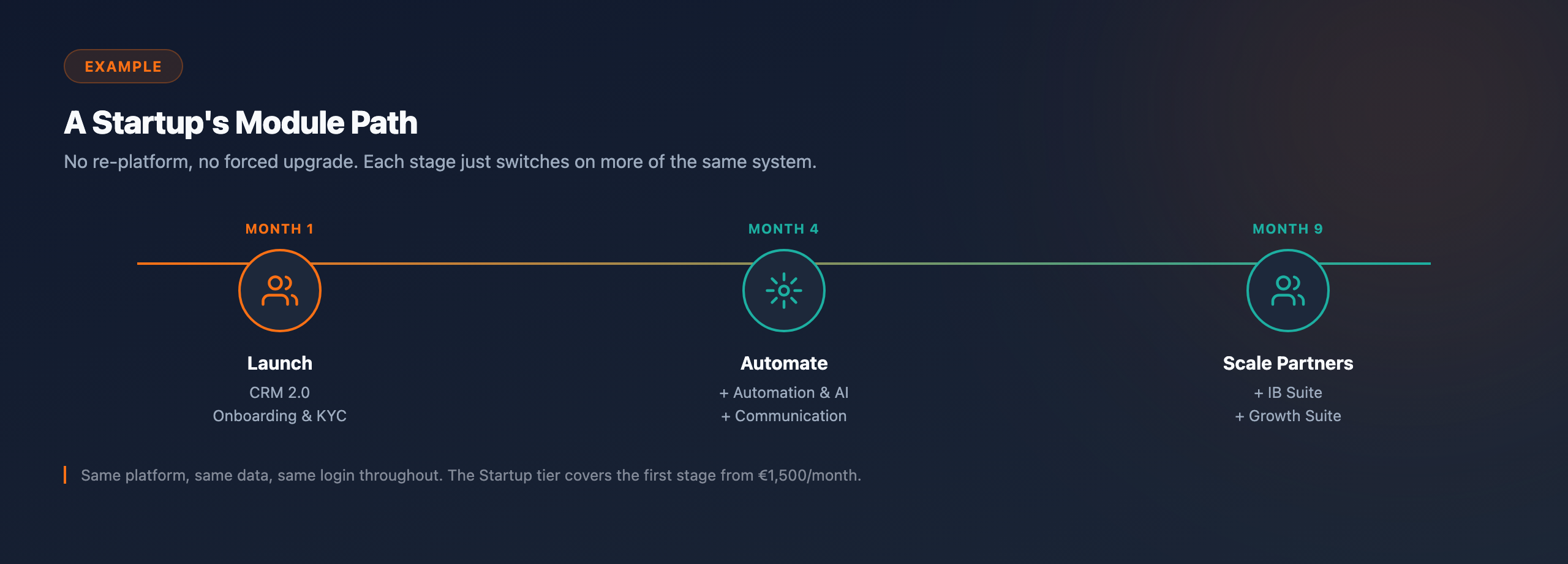
A startup's modular path on one platform: launch on CRM 2.0 with onboarding and KYC, switch on automation and communication as you grow, then add the IB and growth suites, with no re-platforming between stages.
The infrastructure has to scale past launch
The CRM decision a startup makes on day one is one it will live with through its hardest growth. The worst time to discover a CRM can't scale is the moment a brokerage is finally growing fast, when re-platforming means migrating live clients, balances, and compliance records mid-flight. That's a project no growing broker wants, and it's entirely avoidable by choosing infrastructure built to scale from the start.
This is where a platform's breadth matters. TradeCore connects to eight trading platforms, including MT4, MT5, cTrader, and DXtrade, and offers more than 200 integrations, so a startup isn't locked into today's choices. The same system that runs a brand-new broker's first hundred clients also runs established brokerages, which means growth adds volume without forcing a change of system. A CRM that scales is the difference between growth that compounds and growth that keeps breaking the tools underneath it: the failure mode we described in why brokerages fail because of outdated CRMs.
When should a new brokerage put a CRM in place?
Before the first client funds an account. The CRM is what verifies that client, processes their deposit, tracks their activity, and attributes them to the partner who referred them, so it needs to exist the moment onboarding does. Bolting it on later means re-entering history and untangling months of manual workarounds. A brokerage startup that treats the CRM as launch infrastructure, on the same footing as the trading platform, starts clean and stays that way. Brokers building toward launch can start from our solution for startup brokers.
The bottom line
A brokerage startup doesn't need a CRM because bigger brokers have one. It needs a CRM because a forex or CFD brokerage is, from its first day, a regulated business that verifies clients, moves money, tracks trading, and pays partners, all at once. Those functions are not optional and they are not separable: the CRM is simply the system that runs them as one operation instead of five disconnected ones.
That's what a purpose-built platform like BrokerIQ is designed to be for a new broker: the operational foundation a brokerage launches on, rather than something it retrofits once the cracks show. Get it right at the start, and every client, deposit, and partner is captured cleanly from day one.
See a brokerage CRM built for launch
Book a demo to see how a purpose-built brokerage CRM handles KYC, payments, lifecycle automation, and partner management from your very first client.
Frequently Asked Questions
Related guides
Tags
Ready to Get Started?
Discover how TradeCore can help you build and scale your forex brokerage with our comprehensive CRM.