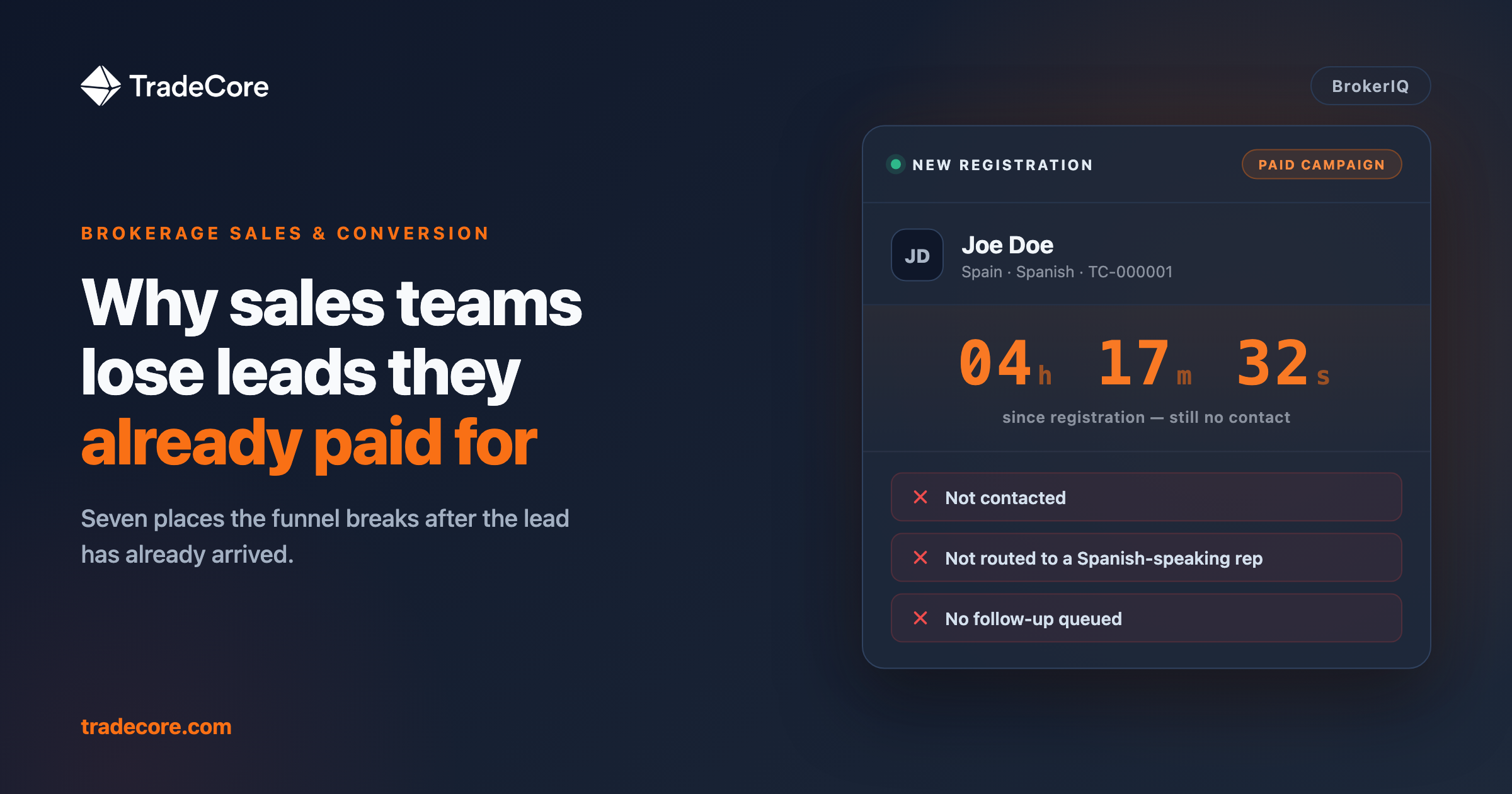
Generating leads is expensive. Brokerages invest heavily in paid media, affiliates, introducing brokers, events, content, and regional campaigns to bring potential clients into the sales funnel. Yet a surprising amount of that investment is lost after the lead has already arrived.
The problem is not always lead quality. Often, brokerage sales teams lose potential clients because of slow follow ups, poor lead routing, missing customer information, manual processes, and limited CRM automation.
A lead registers, but nobody calls quickly enough. Another starts onboarding but never completes KYC. A potential client deposits but never places their first trade. Another speaks with one sales representative and later receives a generic message from someone who has no context about the previous conversation.
Individually, these may look like small operational problems. At scale, they become a serious conversion and revenue problem.
1. Slow Follow Ups Kill Brokerage Lead Conversion
Speed matters when someone registers with a broker. A prospect who has just completed a registration form is at one of the highest intent moments in the customer journey. If that lead sits untouched in the brokerage CRM for hours, or until the next working day, the sales team is already at a disadvantage.
The prospect may have registered with another broker, continued researching competitors, or simply lost interest. This is where CRM automation can support brokerage sales teams.
A new registration can automatically trigger an action, assign the lead to the right salesperson based on language, country, campaign, or acquisition source, and immediately notify the sales representative. Automation does not replace the salesperson. It helps the salesperson reach the prospect while the opportunity is still warm.
2. Poor Lead Routing Creates Missed Opportunities
Not every brokerage lead should follow the same sales process. A prospect from Spain may require a different sales representative from a prospect in the UAE. An experienced trader may require different communication from someone opening their first trading account. A high value affiliate lead may also deserve different treatment from a low intent campaign registration.
Yet many brokerage sales operations still rely on basic round robin assignment or manual lead distribution.
Effective lead routing can consider language, region, campaign, acquisition source, account type, client value, previous activity, and sales team availability. When routing becomes more intelligent, sales managers are not simply distributing leads. They are matching opportunities with the salespeople most likely to convert them.
3. Sales Teams Don't Have Enough Client Context
A salesperson should understand the client's journey before starting a conversation. Where did the lead come from? Which campaign generated the registration? Has the client completed KYC? Have they attempted a deposit? Have they spoken with another team member? Have they contacted customer support? Are they associated with an IB or affiliate? Have they traded before?
When brokerage technology is fragmented across multiple platforms, answering these questions quickly becomes difficult.
This creates situations where a salesperson asks whether a client has completed verification when KYC was completed yesterday, or asks about a deposit that was already made that morning.
The brokerage may technically have the data, but the sales team does not have the context when they need it. A modern brokerage CRM should provide a unified customer view that allows sales representatives to understand the full client journey before making contact.
4. Brokerage Sales Teams Spend Too Much Time on Manual Tasks
Salespeople should be selling, but a significant part of the working day can disappear into administrative work: updating CRM statuses, writing follow up emails, creating reminders, checking KYC status, looking for payment information, moving leads between pipelines, updating spreadsheets, and searching through previous conversations.
One manual task may seem insignificant. Multiply it by every salesperson, every lead, and every working day, and it becomes a major operational cost.
CRM automation should remove repetitive work surrounding the sales process. If a client has not completed KYC after a certain period, the system can trigger a follow up. If verification is completed, the account manager can be notified. If a deposit is made, the client's sales stage can update automatically. If a high value lead becomes active again, the relevant salesperson can receive an alert.
The objective is not to automate every customer interaction. It is to automate predictable processes so sales teams can focus on conversations that require human involvement.
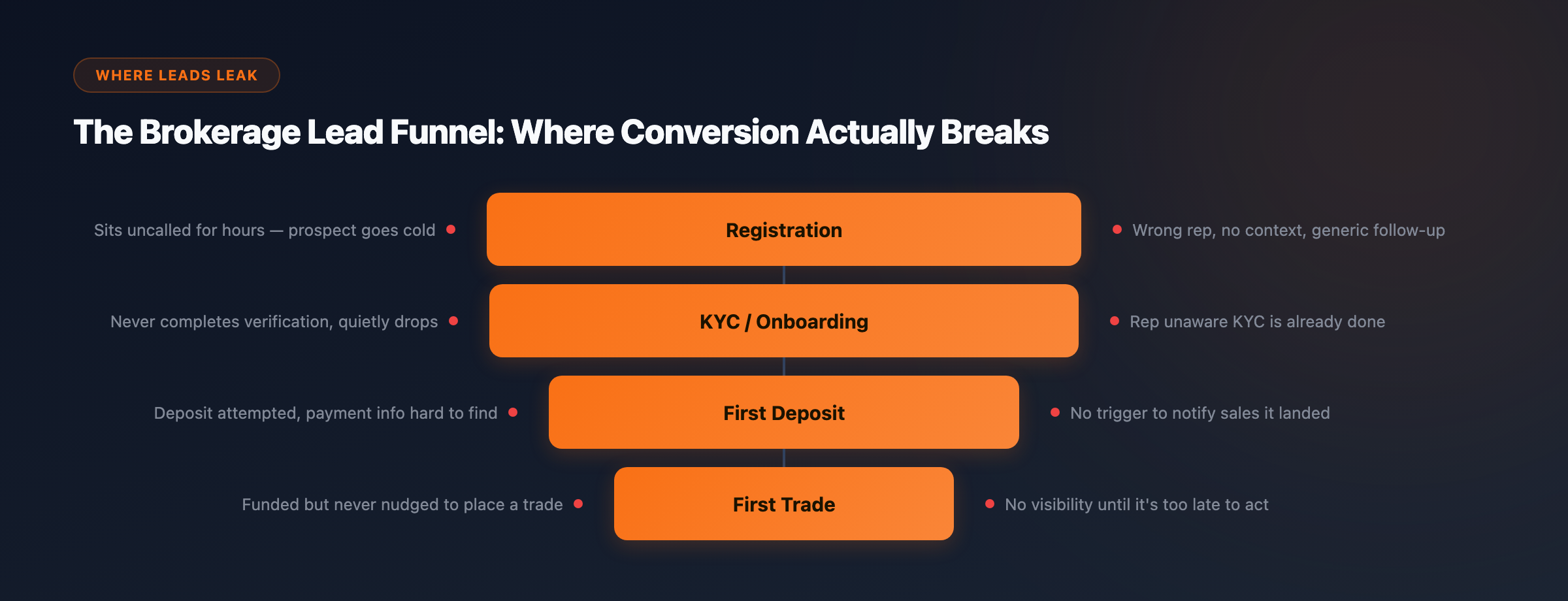
The brokerage lead funnel showing where conversion breaks down at each stage: registration, KYC and onboarding, first deposit, and first trade.
5. Every Brokerage Lead Gets the Same Follow Up
One of the biggest mistakes in sales automation is assuming that automation means sending more messages. Effective brokerage CRM automation should instead make communication more relevant.
A lead who registered five minutes ago is different from someone who completed KYC three days ago but has not deposited. A funded client who has not started trading requires another approach, while an inactive high value client represents a completely different retention opportunity.
Brokerages can build automated client journeys around actual behaviour, including registration without KYC, KYC completion without deposit, deposit without first trade, previously active clients becoming inactive, dormant clients returning, and high value clients showing signs of disengagement.
The brokerage CRM should help the sales team understand what needs to happen next, rather than simply storing what happened before.
6. Sales Managers Discover Conversion Problems Too Late
A Head of Sales should not have to wait until the end of the week to discover that hundreds of leads from Monday's campaign were barely contacted.
Sales managers need real time visibility into lead response times, follow up activity, conversion rates, campaign performance, regional performance, KYC completion, deposits, and trading activation.
How quickly are new leads being contacted? How many leads have not received a follow up? Which sales representatives are converting? Which marketing campaigns produce deposits rather than registrations? Where are prospects dropping out of the sales funnel? How many verified clients never deposit? How many funded clients never trade?
Good brokerage CRM reporting is not simply about measuring sales performance after the fact. It should help management identify problems while there is still time to change the outcome.
7. Brokerage Sales Teams Work Across Too Many Systems
Many brokerage sales teams work across multiple disconnected systems. The CRM may be open in one window, communication tools in another, KYC information somewhere else, payment information in another system, trading activity on the trading platform, and customer support history in a separate solution.
The information exists, but accessing it at the moment it matters becomes difficult.
Modern brokerage sales operations need more than a database containing names, phone numbers, and account statuses. They need an operational layer connecting CRM, KYC, payments, communications, trading platforms, IB and affiliate management, and customer support.
The Real Problem Isn't Always Lead Generation
When brokerage conversion rates slow, the natural reaction is often to generate more leads. Increase the advertising budget, launch another campaign, recruit more affiliates, or enter another market.
But before spending more money at the top of the funnel, brokerages should ask a different question: how many existing opportunities are already being lost inside the sales funnel?
Improving brokerage lead conversion does not always require more traffic. Sometimes it requires faster follow ups, better lead routing, clearer client information, smarter CRM automation, and better visibility for sales managers.
A brokerage generating 10,000 leads does not necessarily need 12,000. It may need to become significantly better at converting the 10,000 leads it already has.
From Brokerage CRM to Brokerage Operating System
The role of brokerage CRM software is changing. A CRM should no longer simply tell a salesperson who the client is. It should help determine what needs to happen next.
At TradeCore, this is one of the ideas behind BrokerIQ. Rather than treating CRM, client onboarding, automation, communications, IB and affiliate management, and brokerage integrations as completely separate workflows, BrokerIQ brings them together within a modular brokerage operating system.
For brokerage sales teams, this means creating workflows where client activity can trigger the right action at the right moment while giving sales representatives the customer context they need before starting a conversation.
Better brokerage sales performance is not only about having better salespeople. It is also about giving good salespeople the technology, automation, and information they need to convert more opportunities.
How Many Brokerage Leads Are You Actually Losing?
Every brokerage tracks leads. Most track deposits, and many track conversion rates. But fewer brokerages investigate why the people between registration and deposit did not convert.
How many leads waited too long for a call? How many received the wrong follow up? How many disappeared during onboarding or KYC? How many were contacted by a salesperson who did not understand their previous activity?
And most importantly, how many could have become active traders if the right action had happened at the right moment?
Before investing in more leads, it may be worth looking more closely at the opportunities already sitting inside your brokerage CRM.
Ready to Get Started?
Book a demo to see how BrokerIQ helps your sales team follow up faster, route leads smarter, and stop losing opportunities you already paid for.
Frequently Asked Questions
Related guides
Tags
Ready to Get Started?
Discover how TradeCore can help you build and scale your forex brokerage with our comprehensive CRM.