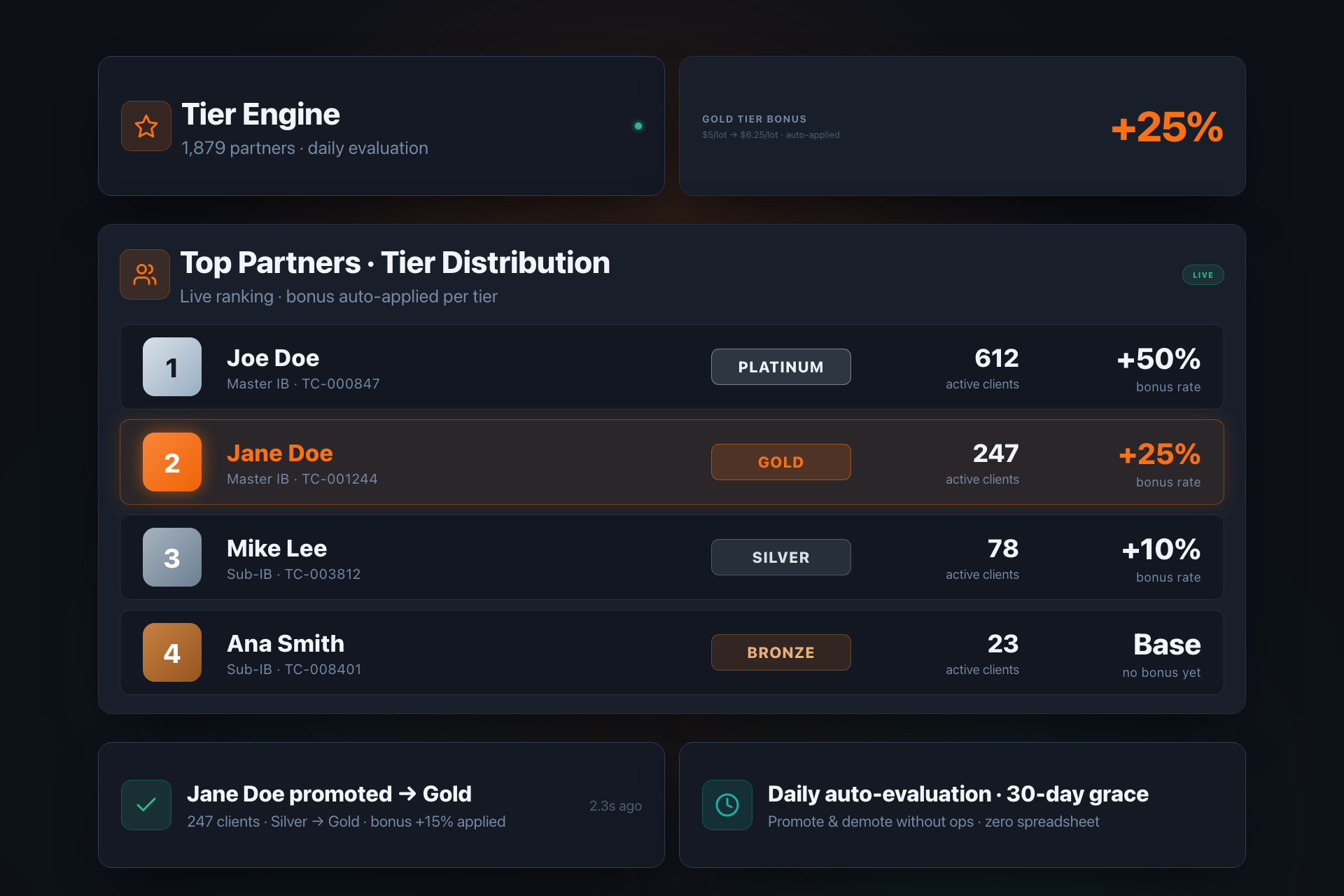
An IB commission tier is a level on a partner ladder that pays a higher commission rate to introducing brokers (IBs) and affiliates who hit defined performance thresholds. A broker configures a tier program inside the forex CRM, partners climb the ladder based on activity, and the tier they sit on determines the bonus on top of their base commission rate. A higher tier means a higher effective rate per lot, per CPA, or per challenge sale.
Tier programs exist because flat commission rates undercompensate the partners who actually move the business. A broker paying every IB the same $5 per lot is paying the IB with 500 clients the same per-lot rate as the IB with 5. Tiers fix this by linking rate to performance, automatically.
What does a typical IB tier program look like?
The most common shape is four tiers, named by metal:
| Tier | Typical Condition | Typical Bonus |
|---|---|---|
| Bronze | Default (no promotion required) | Base rate, no bonus |
| Silver | 50+ active clients | +10% on commissions |
| Gold | 200+ active clients | +25% on commissions |
| Platinum | 500+ active clients | +50% on commissions |
Bronze
- Typical Condition
- Default (no promotion required)
- Typical Bonus
- Base rate, no bonus
Silver
- Typical Condition
- 50+ active clients
- Typical Bonus
- +10% on commissions
Gold
- Typical Condition
- 200+ active clients
- Typical Bonus
- +25% on commissions
Platinum
- Typical Condition
- 500+ active clients
- Typical Bonus
- +50% on commissions
The names are convention, not a requirement. A broker can name tiers VIP/Elite/Diamond or by partner code (T1/T2/T3) or anything else. The mechanics are the same: each tier has promotion conditions to climb to it, retention conditions to stay on it, and a bonus that lifts the base commission rate while the partner is on that tier.
Promotion conditions are configurable per program. The common variables:
- Active clients. Number of referred clients who traded in the evaluation window.
- FTD count. Number of referred clients who made a first deposit at or above a minimum.
- Total deposits. Cumulative deposit volume across referred clients in the window.
- Lots traded. Cumulative lots traded across referred clients.
- Custom combinations. Multiple conditions joined with AND (must hit all) or OR (any one).
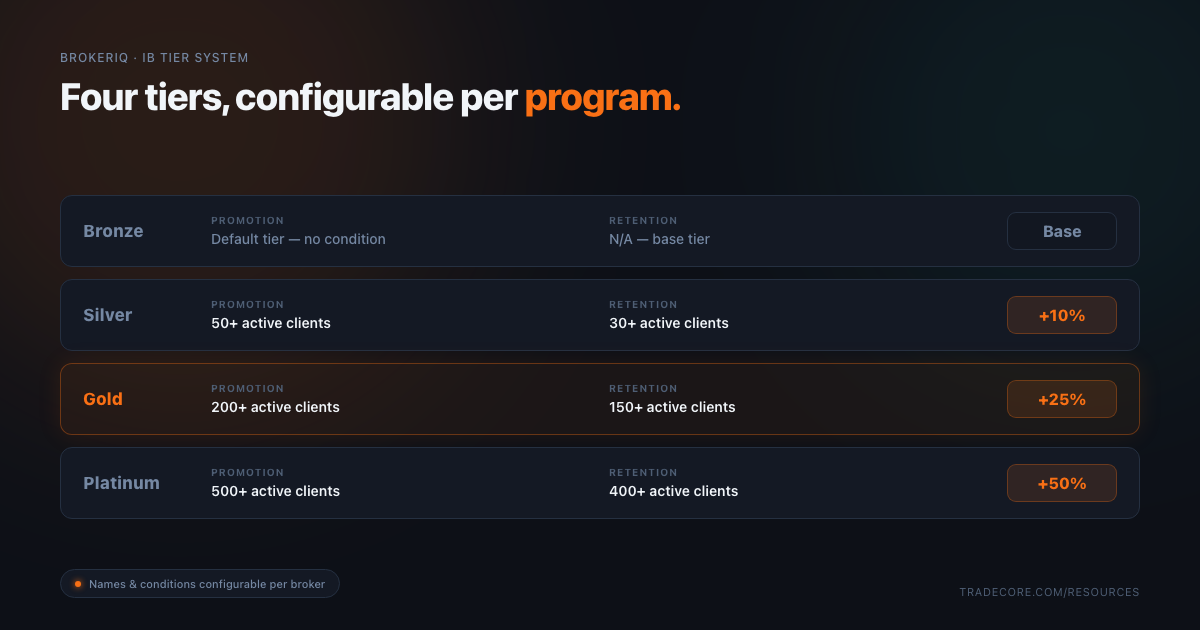
Bronze, Silver, Gold, Platinum tier ladder with promotion conditions, retention thresholds, and bonus rates.
A broker can configure Silver as "50 active clients AND $50,000 total deposits" to filter out partners who hit one number but not the other. The flexibility matters because the conditions that signal a serious partner are different in different broker books.
What is a retention threshold and why is it not the same as a promotion threshold?
A retention threshold is the minimum performance a partner must maintain to stay in a tier they already reached. It is deliberately set lower than the promotion threshold to prevent partners from cycling in and out of tiers month after month.
An example. Silver promotion condition: 50+ active clients in the evaluation window. Silver retention condition: 30+ active clients. A partner who promotes to Silver in March on 52 active clients drops back if April's activity falls below 30 active clients. Activity between 30 and 49 leaves them on Silver. Activity at 50+ keeps them on Silver. Activity below 30 starts the demotion clock.
The gap between promotion and retention thresholds is what creates the platform's notion of a stable tier. Without it, a partner sitting at 50 active clients exactly would oscillate between Bronze and Silver every evaluation. With a retention threshold of 30, the partner has a 20-client buffer of stability after promotion.
A broker configures retention thresholds per tier. Stronger platforms enforce that the retention threshold cannot exceed the promotion threshold (otherwise no one would ever retain after promotion).
What is a grace period and why does it exist?
A grace period is a forgiveness window after a partner falls below the retention threshold, during which the partner stays in the tier instead of being demoted immediately. The partner has a defined number of days (commonly 30 or 60) to recover activity before the demotion fires.
Why grace periods exist: real partner activity is bumpy. A Main IB whose top sub-partner took a two-week holiday in August can dip below retention for that month and recover in September. Demoting the partner instantly in August would penalise normal business variance.
The grace period has its own mechanics:
- Trigger. Partner falls below the retention threshold at the next evaluation.
- State. Partner is marked "in grace" while staying in the tier with the tier's bonus rate still applied to their commissions.
- Resolution. If the partner returns above the retention threshold during the grace window, they exit grace and stay in the tier. If the grace window expires without recovery, the partner is demoted and the tier's bonus rate stops applying.
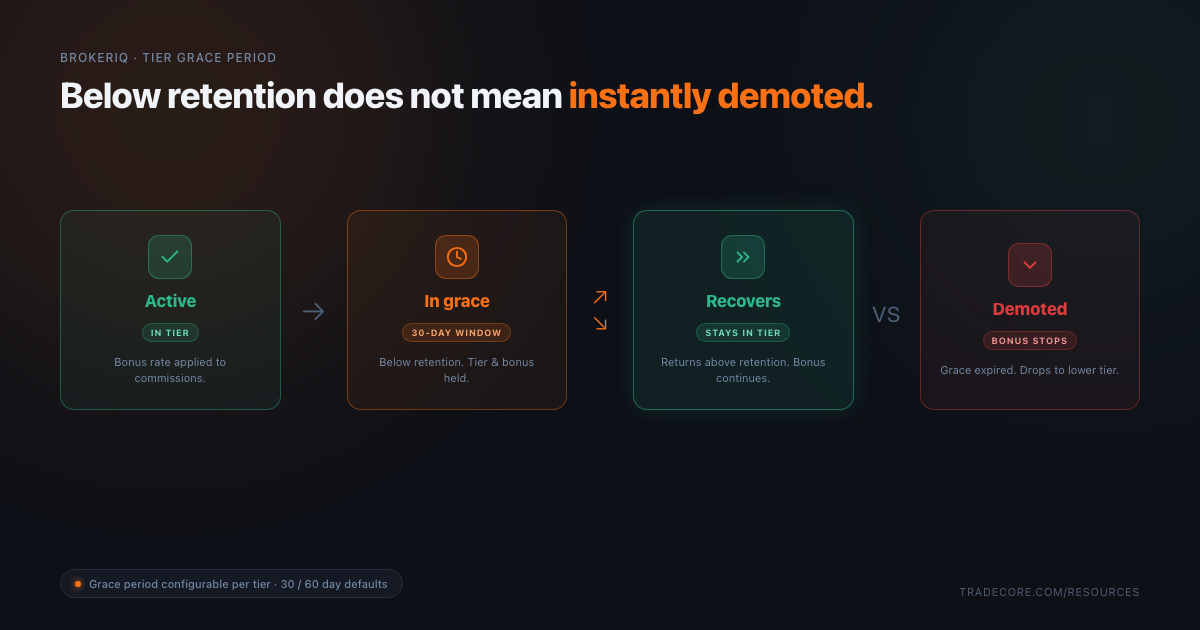
Grace period flow — Active to In grace to Recovers or Demoted.
Stronger platforms allow per-tier grace configuration. A broker might give Platinum partners a 60-day grace (most valuable, deserve more patience) and Silver partners a 30-day grace.
How often does the system evaluate tiers?
Tier evaluation runs on a schedule, typically daily. The job:
- 1. For every active partner, calculate the relevant metrics (active clients, FTDs, deposits, lots) over the configured evaluation window.
- 2. Compare the metrics against each tier's promotion and retention thresholds.
- 3. Apply promotions (partner exceeds a higher tier's promotion threshold), demotions (partner falls below retention and the grace period expired), and grace transitions (partner falls below retention with grace still in window).
- 4. Update the partner's tier record, log the transition, and apply the new bonus rate to future commissions.
Daily evaluation matters because a partner who hits the Gold threshold today should not wait until next month's manual review to start earning Gold rates. The platform's job is to keep the tier in sync with reality without the broker's operations team being in the loop.
On weaker platforms tier evaluation is a manual operations task: a team member runs reports, compares against thresholds, and updates partner records by hand. This is functional at 10 partners and starts to break at 100.
How does a tier upgrade change the commission calculation?
Two modes exist for how a tier upgrade applies to commissions:
- Progressive. The new tier's bonus applies to commissions generated after the upgrade. Commissions already calculated at the lower tier stay at the lower rate.
- Accumulative. The new tier's bonus retroactively recalculates pending commission records in the current cycle. A partner who upgrades to Gold mid-cycle gets the Gold rate applied to commissions earned earlier in that cycle but not yet paid out.
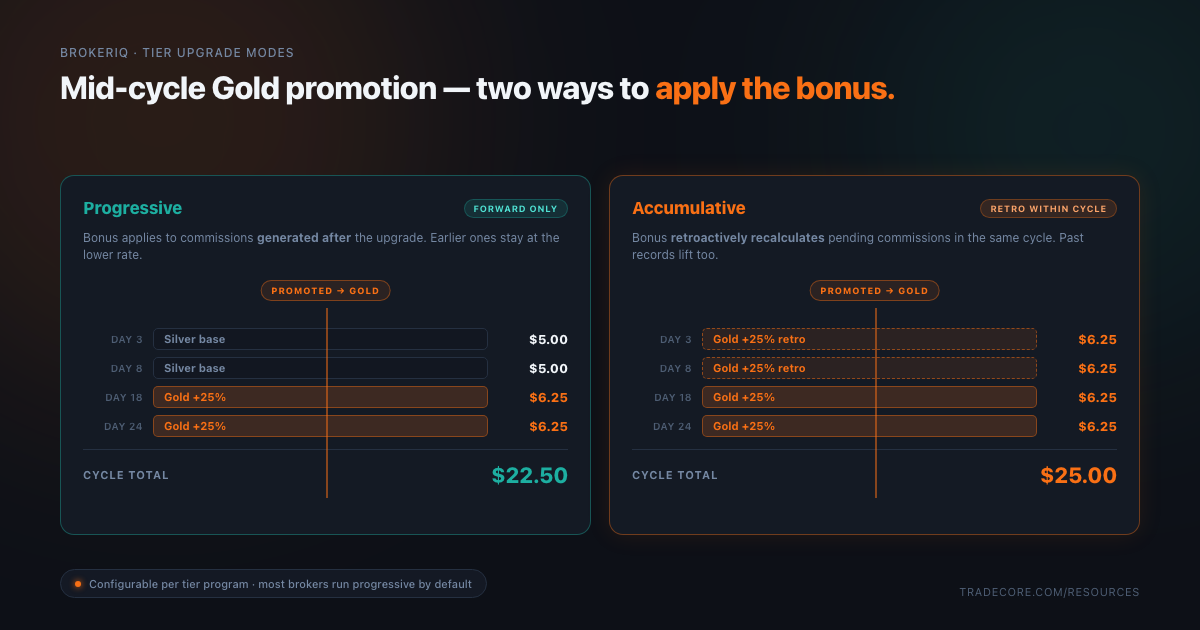
Progressive vs Accumulative bonus calculation — same Gold promotion, two different cycle totals.
Most brokers run progressive by default because it is simpler to explain and audit. Accumulative is used as a retention or onboarding lever: "if you make Gold in your first 90 days, the boost applies to everything you earned during the climb."
The bonus itself can be configured two ways:
- Percentage boost. Tier multiplies the base rate. Gold at +25% means a $5/lot base rate becomes $6.25/lot while the partner is on Gold.
- Flat amount per commission. Tier adds a fixed dollar amount to each commission record, independent of the base rate.
Percentage is the standard. Flat-amount bonuses are used for special programs (a one-off cash bonus for reaching a tier).
What is the difference between tier bonuses and base commission rules?
The base commission (in BrokerIQ's IB Suite, the partner's keep in the governing deal: a per-lot amount, a spread or commission share, a CPA bounty) determines the partner's underlying rate. The tier system sits on top of it as a multiplier or addend. Tiers do not replace the deal. They scale it.
A partner on a $5/lot deal with no tier earns $5/lot. The same partner on Gold (+25%) earns $6.25/lot. The same partner demoted back to Bronze earns $5/lot again. The deal stays constant. The tier moves.
This separation matters because it lets a broker change tier structures (introduce a new Platinum, adjust Silver thresholds) without rewriting deals across every partner. The base deal is the contract. The tier is the performance overlay.
Does TradeCore handle IB tiers?
Yes. BrokerIQ by TradeCore ships a configurable tier programme on TradeCore's Core plan, with the full mechanics described above: per-tier promotion conditions (active clients, FTD count, total deposits, lots traded, with AND/OR logic), retention thresholds set separately from promotion, a configurable grace period, daily automated evaluation, and both progressive and accumulative calculation modes. Bonuses can be configured as percentage boosts or flat amounts per commission. Custom perks (VIP support, higher limits) can be attached to a tier as display attributes the Partner Hub surfaces alongside the bonus.
To see the IB tier system live, book a 20-minute demo any week. We run it on a live brokerage against your real partner economics.
For deeper context, see the eight IB-system differentiators most forex CRMs do not have, or start with the basics in What Is an IB System in a Forex CRM?. To talk to TradeCore, get in touch any time.
Frequently asked questions
Related guides
Tags
Ready to Get Started?
Discover how TradeCore can help you build and scale your forex brokerage with our comprehensive CRM.